
Reverse Mortgages in Alberta — Your Complete Guide
Written by Shawn Selanders | RECA-Licensed Mortgage Broker | 25+ Years Experience | Updated February 2026
If you're 55 or older, own your home, and need access to cash — a reverse mortgage lets you tap into your home equity without selling, moving, or making monthly mortgage payments.
This page is designed to give you everything you need to understand how reverse mortgages work in Canada, what they cost, who qualifies, and whether one makes sense for your situation. No sales pitch — just the facts, explained in plain language.

Why I Built This Page
I've been a mortgage broker in Alberta since 1999. Over the past several years, reverse mortgages have become one of the most common conversations I have with clients. The questions are always the same: "Is this legitimate?" "Will the bank take my house?" "How much can I get?"
The problem is that most of the information online is either too vague, too technical, or written by the lenders themselves. I wanted to create something different — a straightforward, Alberta-focused guide written by someone who actually arranges these mortgages every day.
If you have questions after reading this, call me. That's what I'm here for.
What's on This Page
- What Is a Reverse Mortgage?
- How Does It Actually Work?
- Who Qualifies?
- How Much Can You Get?
- Reverse Mortgage Lenders in Canada
- What Does It Cost?
- Pros and Cons — The Honest Version
- 8 Common Myths — Busted
- Who Typically Uses a Reverse Mortgage?
- Reverse Mortgage vs. HELOC vs. Downsizing vs. Refinancing
- The Process — Step by Step
- Reverse Mortgages and Alberta Specifically
- What Your Family Should Know
- Frequently Asked Questions
- Resources and External Links
- Talk to Shawn — Free Consultation
1. What Is a Reverse Mortgage?
A reverse mortgage is a loan that lets Canadian homeowners aged 55 and older borrow against the equity in their home — without having to sell it, move out, or make monthly mortgage payments.
Think of it this way: with a regular mortgage, you make payments to the bank each month and your loan balance goes down over time. With a reverse mortgage, you receive money from the lender and your loan balance goes up over time (because interest is added to what you owe).
You don't repay the loan until you sell the home, move out permanently, or pass away. Until then, you continue to own your home, live in your home, and make all the decisions about your home.
The Key Facts at a Glance:
- You must be 55+ (all owners on title must be 55+)
- No monthly mortgage payments required
- You retain full ownership of your home
- The money is tax-free — it's a loan, not income
- Doesn't affect your OAS or GIS benefits
- You can borrow up to 55-59% of your home's appraised value (depending on lender, age, and location)
- You never owe more than your home is worth (no negative equity guarantee)
2. How Does It Actually Work?
Here's the simplest way to understand it:
Regular Mortgage
You borrow money to buy a home.
You make monthly payments.
Your balance goes down each month.
Reverse Mortgage
You borrow money from your home's equity.
No monthly payments required.
Your balance goes up as interest accrues.
How you receive the money:
You have options depending on the lender and product:
- Lump sum — receive all the money at once (most common)
- Scheduled payments — receive regular monthly or quarterly amounts (available with some products)
- Combination — an initial lump sum plus regular payments or a line of credit for future draws
When does the loan get repaid?
The reverse mortgage becomes due when the last borrower on the title:
- Sells the home
- Moves out permanently (e.g., into a care facility)
- Passes away
Important: If two people are on the mortgage and one needs to move into a care home, the other can stay in the home and the reverse mortgage continues. It only becomes due when the last person on title leaves or passes away.
3. Who Qualifies?
The qualification requirements are actually simpler than a regular mortgage. Here's what matters:
Eligibility Requirements:
Age: You must be at least 55 years old. If there are two people on the title, both must be 55+. If your spouse is 53, you'll need to wait until they turn 55.
Home: Must be your primary residence (you live there at least 6 months per year). Second homes, vacation properties, and rental properties don't qualify.
Property type: Most homes qualify — detached, semi-detached, townhouses, condos. The home must be in good condition with property taxes paid and insurance current.
Home value: Minimum $250,000 appraised value (may be slightly lower with some lenders and products).
Location: Must be in Canada. Both major lenders serve Alberta, including Calgary, Edmonton, and smaller communities. HomeEquity Bank (CHIP) has the broadest geographic reach, including rural areas.
Income and credit: Here's the good news — your income and credit score are generally not qualifying factors. Since you're not making monthly payments, lenders don't need to verify your ability to service the debt the same way they do with a traditional mortgage.
Already have a mortgage? You can still qualify. However, your existing mortgage (and any HELOC) must be paid off when the reverse mortgage is set up. The reverse mortgage funds are typically used to pay off that existing balance first, and you receive whatever is left over.
4. How Much Can You Get?
The amount you can borrow depends on several factors:
- Your age — the older you are, the more you can access
- Your home's appraised value
- Your home's location (urban vs. rural)
- Property type and condition
- Your current mortgage balance (if any — it gets paid off from the proceeds)
General Borrowing Guidelines:
At age 55, you may qualify for approximately 15–20% of your home's value.
At age 65, approximately 25–35% of your home's value.
At age 75, approximately 35–45% of your home's value.
At age 80+, up to 50–59% of your home's value.
These are general ranges. Your actual amount will depend on the specific lender, product, and your circumstances. I can get you a personalized estimate in about 15 minutes.
A quick example:
A 72-year-old couple in Calgary with a home appraised at $650,000 and no existing mortgage might qualify for approximately $227,500 to $260,000 in tax-free cash (roughly 35–40% of home value).
If they still owed $80,000 on an existing mortgage, that would be paid off first, leaving them with approximately $147,500 to $180,000 in accessible funds.
Both CHIP and Equitable Bank offer free online calculators to estimate your amount:
5. Reverse Mortgage Lenders in Canada
Unlike regular mortgages (where dozens of banks and lenders compete), there are only a handful of reverse mortgage providers in Canada. Here are the main ones:
HomeEquity Bank — The CHIP Reverse Mortgage
- Canada's original and largest reverse mortgage provider (since 1986)
- Available across Canada, including urban and rural Alberta
- Access up to 55% of your home's value
- Fixed and variable rate options
- Lump sum or scheduled payment options
- Also offers the Bloom program (draw funds as needed over time)
- Rated 4.8/5 on Trustpilot (1,000+ reviews)
- Available directly or through mortgage brokers like me
Equitable Bank — Reverse Mortgage Flex
- Canada's Challenger Bank™ — growing fast in the reverse mortgage space
- Available in Alberta's major urban centres (Calgary, Edmonton, and surrounding areas)
- Access up to 59% of your home's value (slightly higher than CHIP)
- Offers Flex, Flex Plus, and Flex Lite products for different needs
- Rate match guarantee — they'll beat any comparable reverse mortgage rate posted in Canada
- $995 setup fee (occasionally waived during promotions)
- Available through mortgage brokers only (not directly)
Why use a broker? As your mortgage broker, I can access both HomeEquity Bank and Equitable Bank products and compare them side by side to find the best fit for you. I can also negotiate on your behalf. For most mortgages, the lender pays me a commission — my service typically costs you nothing.
6. What Does It Cost?
Let's be upfront about costs — this is where many people have concerns, and I want to give you the full picture.
Interest Rates
Reverse mortgage rates are higher than traditional mortgage rates. That's just the reality. There are good reasons for it: the lender doesn't receive any payments for years (the average reverse mortgage lasts 7–12 years before repayment), and they guarantee you'll never owe more than your home is worth. That's more risk for the lender, which means higher rates.
Typical Rate Ranges (as of early 2026):
5-year fixed: approximately 6.5% to 7.5% (varies by lender and product)
Variable: approximately 6.5% to 8.0% (tied to prime rate + premium)
Rates change regularly. Call me for the current rates that apply to your situation — I can typically quote you in minutes. These are general ranges only, O.A.C.
Other Costs to Expect
- Home appraisal: $300–$600 (required to determine your home's current value)
- Legal fees: $800–$1,500 (you need independent legal advice — Alberta may require this)
- Setup/admin fee: $995 with Equitable Bank (HomeEquity Bank may include this in the rate or charge separately depending on product)
- Prepayment penalties: If you pay off the reverse mortgage before the term ends (e.g., you sell early), there may be a penalty. This works similarly to breaking a traditional fixed-rate mortgage.
Many of these costs can be deducted from the reverse mortgage proceeds, so you typically don't need to come up with cash out of pocket.
Can You Make Payments If You Want To?
Yes. Although no payments are required, both lenders allow you to make voluntary prepayments. This can help slow the growth of your loan balance. Some borrowers choose to pay the interest each month to keep the balance from growing. This is entirely optional.
7. Pros and Cons — The Honest Version
I'm not going to sugarcoat this. A reverse mortgage is a powerful tool, but it's not right for everyone. Here's both sides.
✅ The Advantages
- Access tax-free cash without selling your home
- No monthly mortgage payments required
- You keep full ownership and control
- Won't affect your OAS or GIS benefits
- Income and credit score aren't key qualifying factors
- No negative equity guarantee — you'll never owe more than your home is worth
- Use the money for anything — no restrictions
- Can pay off existing mortgage, HELOC, or credit card debt
- One spouse can stay if the other moves to care
⚠️ The Drawbacks
- Higher interest rates than traditional mortgages
- Interest compounds over time — the loan balance grows
- Reduces the equity available to your heirs/estate
- Upfront costs (appraisal, legal, setup fees)
- May limit other financing options on your home
- Prepayment penalties if you pay off before term ends
- Limited lender competition (only 2–3 providers in Canada)
- Estate must repay within a set timeframe after passing
- Not suitable for short-term needs (costs are front-loaded)
8. Common Myths About Reverse Mortgages — Busted
These are the concerns I hear most often. Let me set the record straight.
MYTH: "The bank will own my home."
FACT: You retain full ownership of your home. The reverse mortgage is a lien against the property — exactly the same as a regular mortgage. The lender does not take title.
MYTH: "I could end up owing more than my home is worth."
FACT: Both major lenders offer a no negative equity guarantee. As long as you've met your obligations (property taxes, insurance, maintenance), you will never owe more than the fair market value of your home at the time of sale.
MYTH: "Reverse mortgages are only for people who are desperate."
FACT: Many clients use reverse mortgages strategically — to supplement retirement income, avoid selling investments at a loss, fund home renovations for aging in place, help a child with a down payment, or simply improve monthly cash flow. It's a financial planning tool, not a last resort.
MYTH: "My children will be stuck with the debt."
FACT: Reverse mortgages in Canada are non-recourse. That means the loan is repaid from the sale of the home. If the home sells for more than the loan balance (which is the case in the vast majority of situations), the remaining equity goes to your estate. Your children are not personally liable for any shortfall.
MYTH: "The money from a reverse mortgage is taxable income."
FACT: The money you receive is a loan, not income. It is not taxable and does not need to be reported on your tax return. It also does not affect your eligibility for OAS or GIS.
MYTH: "I have to have my home fully paid off to qualify."
FACT: You can qualify with an existing mortgage. The reverse mortgage proceeds are used to pay off the existing balance first, and you receive the remaining funds. In fact, this is one of the most common uses — eliminating monthly mortgage payments to improve cash flow.
MYTH: "I can't sell my home if I have a reverse mortgage."
FACT: You can sell at any time. You simply repay the reverse mortgage balance (plus any prepayment charges, if applicable) from the sale proceeds. The remaining equity is yours.
MYTH: "There won't be anything left for my family."
FACT: On average, CHIP reports that their customers retain over 50% of their home's value after repaying the loan. Home appreciation helps — especially in Alberta's growing communities. That said, the longer the loan is in place, the more interest accrues, so this is worth discussing with your family.
9. Who Typically Uses a Reverse Mortgage?
In my experience, reverse mortgage clients generally fall into these categories:
Supplementing retirement income: CPP and OAS don't cover what they used to. A reverse mortgage can bridge the gap without selling investments or changing your lifestyle.
Eliminating existing mortgage payments: If you still owe $80K–$200K on your home and the monthly payments are straining your budget, a reverse mortgage can pay off that balance and eliminate the monthly payment entirely.
Home renovations for aging in place: Bathroom modifications, stairlifts, main-floor bedroom conversions. These renovations aren't cheap, but they're a lot less expensive than moving to a care facility.
Helping family: Some clients use reverse mortgage funds to help a child or grandchild with a down payment. You get to see the impact of your help while you're alive — rather than waiting for an inheritance.
Healthcare expenses: In-home care, medications, dental work, mobility equipment. These costs add up quickly and aren't always covered by provincial health care.
Debt consolidation: Paying off high-interest credit cards, lines of credit, or other debts — and eliminating all those monthly payments at once.
Preserving investment portfolios: Rather than selling stocks or RRSPs at an inopportune time, some retirees use a reverse mortgage to access cash while letting their investments recover or continue to grow.
10. Reverse Mortgage vs. HELOC vs. Downsizing vs. Refinancing
People often ask me, "Isn't there a cheaper way to do this?" Fair question. Here's how the options compare:
| Factor | Reverse Mortgage | HELOC | Refinance | Downsizing |
|---|---|---|---|---|
| Monthly payments? | None required | Yes — interest minimum | Yes — full mortgage payment | N/A (you sell) |
| Stay in your home? | Yes | Yes | Yes | No — you move |
| Income required? | No | Yes | Yes (stress test) | No |
| Credit score matters? | Generally no | Yes | Yes | No |
| Interest rate | Higher (6.5–8%) | Lower (prime + 0.5–1%) | Lower (4–5.5%) | N/A |
| Age restriction? | 55+ | None | None | None |
| Best for | Retirees who want to stay home, no payments | Those with income to support payments | Those with income who want best rate | Those ready to move to a smaller home |
My advice: A reverse mortgage is often the right choice when income is limited, you can't qualify for a traditional mortgage or HELOC, or making monthly payments would put too much strain on your budget. But I always explore all options with you first. Sometimes a different solution makes more sense — and I'll tell you that.
11. The Process — Step by Step
Here's exactly what happens when you work with me on a reverse mortgage:
Step 1: Free Consultation (15–30 minutes)
We talk about your situation, your goals, and what you need. I'll give you a preliminary estimate of how much you could access and walk you through the options. No cost, no obligation.
Step 2: Application
If you decide to proceed, we complete a straightforward application. The documentation is minimal compared to a traditional mortgage — typically just ID, proof of property ownership, and a few basic details.
Step 3: Home Appraisal
The lender arranges an independent appraisal of your home to determine its current market value. This typically costs $300–$600 and can usually be deducted from the mortgage proceeds.
Step 4: Approval and Offer
The lender reviews the application and appraisal, then provides a formal commitment letter outlining the approved amount, rate, terms, and conditions.
Step 5: Independent Legal Advice
You meet with a lawyer (your choice or I can recommend one) who reviews the terms with you and ensures you understand the commitment. This step protects you. The legal fees can typically be deducted from the mortgage proceeds.
Step 6: Funding
Once everything is signed and registered, the funds are deposited directly into your bank account. If you have an existing mortgage, it gets paid off first, and you receive the remaining balance. The entire process typically takes 3–4 weeks from application to funding.
12. Reverse Mortgages and Alberta Specifically
There are some Alberta-specific factors worth noting:
- No land transfer tax in Alberta — this doesn't directly impact reverse mortgages, but it does mean that if you decide downsizing is a better option, you won't face a provincial land transfer tax when purchasing a new home (unlike Ontario or B.C.).
- Strong home values in Southern Alberta — Calgary, Okotoks, and surrounding communities have seen solid property appreciation. This helps, because the more your home is worth, the more you can access.
- Rural and small-town availability — HomeEquity Bank (CHIP) serves rural Alberta, which is important for homeowners in communities like High River, Diamond Valley, Nanton, or Claresholm. Equitable Bank tends to focus on larger centres.
- Oil and gas industry retirees — many Alberta retirees have significant home equity but variable pension income. A reverse mortgage can bridge the gap without touching investments during volatile markets.
- Independent legal advice — you will be required to obtain independent legal advice before the reverse mortgage can be finalized. I can refer you to experienced local lawyers who handle these regularly.
13. What Your Family Should Know
I always encourage my clients to involve their family in this conversation — not because they need permission, but because transparency prevents misunderstandings later.
Here's what I typically explain to family members:
- Your parents still own the home. Nothing changes on the title. They are not "giving the house to the bank."
- There will still be equity left. On average, reverse mortgage holders retain over 50% of their home's value. Home appreciation can help offset the loan growth.
- The estate repays the loan when the time comes. The home is sold, the loan is repaid, and any remaining equity goes to the estate. If the home sells for less than the loan balance, your family is not personally liable (non-recourse).
- There are timelines. After the last borrower passes away or moves out permanently, the estate typically has a set period (often 6–12 months) to sell the home and repay the mortgage. Planning ahead helps.
- The alternative may be worse. If Mom or Dad can't afford to stay in the home, the alternative might be selling the house anyway — or struggling with bills, going into debt, or moving to care they don't need yet. A reverse mortgage can preserve their independence and quality of life.
Tip for families: I'm happy to have a three-way call with you and your parents (or adult children) to answer questions together. Sometimes having an independent voice explain the numbers takes the emotion out of the decision.
14. Frequently Asked Questions
Q: What happens if my home decreases in value?
A: The no negative equity guarantee means you will never owe more than the fair market value of your home at the time of sale (as long as you've maintained the property, kept taxes current, and met your mortgage obligations). If the home sells for less than the loan balance, you or your estate is not responsible for the difference.
Q: Can I rent out part of my home?
A: In most cases, yes — as long as it remains your primary residence and you live in the home for at least 6 months per year. A basement suite or room rental is typically fine, but check with your lender.
Q: What if I want to pay off the reverse mortgage early?
A: You can pay it off at any time by selling the home or through other funds. However, if you pay it off before the term ends, there may be a prepayment penalty — similar to breaking a traditional fixed-rate mortgage. Both lenders allow voluntary prepayments within certain limits without penalty.
Q: What ongoing obligations do I have?
A: You must keep your property taxes paid and current, maintain adequate home insurance, keep the property in reasonable condition, and continue to live in the home as your primary residence. These are the same obligations you'd have with any mortgage.
Q: Can I refinance a reverse mortgage into a traditional mortgage later?
A: It's possible, but not always easy. If your financial situation changes (e.g., you start receiving a new income source), you could explore switching to a traditional mortgage with lower rates. However, you'd need to qualify under standard lending rules including the stress test.
Q: How long does the whole process take?
A: Typically 3 to 4 weeks from application to funds in your account. Some cases may take longer if the appraisal is delayed or if there are title issues to resolve.
Q: Does Shawn charge a fee for this service?
A: No. My service costs you nothing. The lender pays brokers a commission when the reverse mortgage funds. There is no cost to you for the consultation, the advice, or the application process.
15. Resources and External Links
Here are trusted resources if you want to do more research on your own. All links open in a new tab so you don't lose this page.
Lender Websites
- CHIP Reverse Mortgage (HomeEquity Bank) ↗ — Canada's largest reverse mortgage provider
- CHIP Reverse Mortgage Calculator ↗ — Estimate how much you could access
- CHIP Current Interest Rates ↗
- CHIP Frequently Asked Questions ↗
- CHIP Advisor ↗ — Educational content and tools from HomeEquity Bank
- Equitable Bank Reverse Mortgages ↗
- Equitable Bank Eligibility Calculator ↗
Government and Consumer Resources
- Government of Canada — Reverse Mortgages ↗ — Official consumer information
- Financial Consumer Agency of Canada (FCAC) ↗
- Real Estate Council of Alberta (RECA) ↗ — Alberta's mortgage broker regulator
More on My Website
16. Talk to Shawn — Free Consultation
If you've read this far, you're serious about understanding your options. That's smart. The next step is a conversation — no pressure, no sales pitch, just straight answers.
Here's what I'll cover in our first call:
- How much you could potentially access based on your age and home value
- Current rates and which lender/product fits your situation best
- Whether a reverse mortgage, HELOC, or refinance makes more sense for your goals
- What the process looks like and what to expect
- Answers to any questions you (or your family) may have
Let's Talk — It Costs You Nothing
I've been arranging reverse mortgages in Alberta for years. I'll give you the straight goods and help you figure out if this is the right move.
Want to keep this information?
📥 Download the Free Guide (PDF)Call/Text: 403-703-6847
Email: Shawn@ShawnSelanders.ca
Office: 614 High View Park NW, High River, AB T1V 1E5
Hours: Monday to Friday: 9:00 – 7:00 | Saturday & Sunday: 12:00 – 5:00
Serving reverse mortgage clients across Alberta, including:
📱 Download My Mortgage App — It's Free
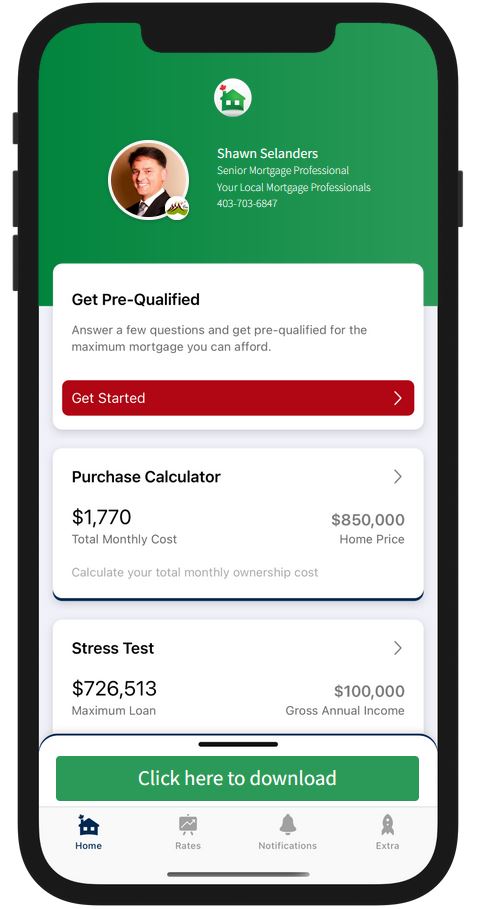
Access real-time rates, mortgage calculators, stress test tools, and more — right on your phone.


Shawn Selanders — RECA-licensed mortgage broker
Your Local Mortgage Professionals — Independent Mortgage Professional
Serving Calgary, Okotoks, High River, and all of Alberta since 1999
This page is for informational purposes only and does not constitute financial advice. Reverse mortgage products are subject to approval. Rates, terms, and eligibility criteria are subject to change. O.A.C. E.&O.E.