
Newcomer Mortgage Alberta — New to Canada Home Buying Guide
Written by Shawn Selanders | RECA-Licensed Mortgage Broker | 25+ Years Experience | Updated February 2026
If you've moved to Canada within the last 5 years, you can buy a home — even without a Canadian credit history. Canada has specific mortgage programs designed for newcomers, with down payments as low as 5%.
Most newcomers assume they need years of Canadian credit and employment before they can qualify for a mortgage. That's not true. Whether you're a permanent resident, landed immigrant, or temporary foreign worker with a valid work permit, there are programs built specifically for you.
This guide explains exactly how newcomer mortgages work in Alberta — what you need, what you don't need, and how to get approved. I've helped newcomers from dozens of countries buy their first Canadian home over the past 25 years.

Why Newcomers Need a Broker
Each bank has ONE newcomer program with its own rules. If you don't fit their criteria, they say no. I compare 20+ lenders — including banks, credit unions, and monoline lenders with newcomer-specific programs. One application, dozens of options.
I know which lenders accept international credit reports, which ones require the least Canadian employment history, and which ones offer the best rates for newcomers. I'll match your situation to the right program.
My service is free to you. The lender pays my fee.
What's on This Page
- Who Qualifies as a "Newcomer"?
- Newcomer Mortgage Programs in Canada
- Down Payment Requirements
- No Canadian Credit History? Here's What to Do
- Employment & Income Requirements
- Documents You'll Need
- Step-by-Step Process
- 5 Myths About Newcomer Mortgages
- Frequently Asked Questions
- Talk to Shawn — Free Assessment
1. Who Qualifies as a "Newcomer"?
For mortgage purposes, a newcomer is someone who has immigrated to Canada within the last 5 years (60 months). After 5 years, you're no longer eligible for newcomer-specific programs — but by then, you'll have Canadian credit history and employment history to qualify through standard channels.
You Qualify for Newcomer Programs If You Are:
- Permanent Resident (PR) — Arrived within the last 5 years with a PR card or Confirmation of Permanent Residence (COPR). Best access to all newcomer programs.
- Landed Immigrant — Same as permanent resident. Full access to newcomer mortgage programs.
- Temporary Foreign Worker — Valid Canadian work permit (typically 12+ months remaining). Access to newcomer programs with some lenders. Down payment requirements may be higher.
- Canadian Citizen Returning from Abroad — Some programs extend to Canadians who were living outside the country and have recently returned with limited Canadian credit/employment history.
Important: Non-Permanent Residents and the Foreign Buyer Ban
Canada's Prohibition on the Purchase of Residential Property by Non-Canadians Act has been extended to January 1, 2027. This restricts some non-Canadians from buying residential property.
However, permanent residents are exempt, as are temporary residents who meet certain conditions (including work permit holders). The rules are complex — I'll confirm whether you're eligible before we proceed.
2. Newcomer Mortgage Programs in Canada
Canada's three mortgage default insurers — CMHC, Sagen, and Canada Guaranty — all offer specific programs for newcomers. These programs allow lenders to approve mortgages with as little as 5% down, even without an established Canadian credit history.
What These Programs Offer:
- Down payment as low as 5% for permanent residents with qualifying income and credit (international credit report accepted)
- Homes up to $1,500,000 are eligible (standard down payment rules: 5% on first $500K, 10% on the rest)
- International credit reports accepted in lieu of Canadian credit history
- Alternative credit proof — 12 months of on-time rent payments, utility bills, insurance payments, or documented savings can substitute for formal credit history
- Minimum 3 months Canadian employment (some programs require less with a higher down payment)
- Up to 30-year amortization for first-time buyers purchasing new construction
Each bank has its own version of these programs with slightly different rules, documentation requirements, and rate offers. RBC, TD, BMO, Scotiabank, CIBC, and National Bank all have newcomer programs — but they're not identical. This is where a broker adds value: I know the differences and match you to the best fit.
3. Down Payment Requirements
| Your Situation | Minimum Down Payment |
|---|---|
| PR with Canadian employment + credit (or international credit report) | 5% (on first $500K, 10% on remainder) |
| PR with Canadian employment but NO credit history | 5–10% (with alternative credit proof: rent, utilities, savings) |
| PR with minimal or no Canadian employment | 35% (some lenders — fewer documentation requirements) |
| Temporary foreign worker (valid work permit) | 10–35% (depends on lender, permit length, and credit) |
| Non-resident / no work permit | 35%+ (very limited options, subject to foreign buyer ban) |
Where Can Your Down Payment Come From?
- Personal savings — From any country. You'll need to show the funds in a Canadian bank account (typically 90 days of history, or a clear paper trail from your home country).
- Gift from a family member — Accepted by most lenders. A signed gift letter is required confirming the money doesn't need to be repaid.
- Sale of property abroad — If you sold a home in your previous country, those funds can be used. Documentation of the sale and the wire transfer is required.
- FHSA (First Home Savings Account) — If you've opened one since arriving, tax-free withdrawals can go toward your down payment.
- RRSP Home Buyers' Plan — Withdraw up to $60,000 tax-free if you qualify as a first-time buyer.
4. No Canadian Credit History? Here's What to Do
This is the biggest concern newcomers have — and it's the most misunderstood part of the process. You do NOT need years of Canadian credit to get a mortgage.
Options If You Have No Canadian Credit:
- International credit report: Many lenders accept credit reports from your home country. If you had a strong credit history abroad, it can substitute for Canadian credit.
- Alternative credit proof (12 months): On-time rent payments, utility bills (gas, water, electricity), cell phone bills, auto insurance, or documented regular savings. You need at least 12 months of consistent, on-time payments.
- Larger down payment (35%): With 35% down, some lenders will approve you with minimal or no credit history and limited Canadian employment. The higher equity reduces their risk.
Start Building Credit Immediately:
Even if you plan to buy in 6–12 months, start building Canadian credit now:
- Get a secured credit card — Most banks offer these to newcomers with no credit. Use it monthly and pay the balance in full.
- Put bills in your name — Cell phone, internet, utilities. On-time payments build your credit file.
- Open a Canadian bank account — Savings history demonstrates financial responsibility.
- Consider a credit-builder loan — Some credit unions offer small loans designed specifically to help newcomers establish credit.
5. Employment & Income Requirements
Standard mortgages typically require 2 years of Canadian employment history. Newcomer programs are more flexible — but you still need to demonstrate income.
| Employment Situation | What Lenders Need |
|---|---|
| Employed 3+ months in Canada | Job letter, recent pay stubs. Standard newcomer qualification. |
| Relocated by employer (international transfer) | Employment contract or transfer letter. Some lenders waive the 3-month requirement. |
| Self-employed newcomer | More complex. Typically need 2 years of Canadian tax returns OR use stated income programs. Self-employed guide → |
| Not yet employed in Canada | 35% down payment with some lenders. Income verification may not be required with sufficient equity. |
Debt ratios still apply. Your total monthly housing costs (mortgage, taxes, heat) should not exceed 39% of your gross income (GDS ratio), and total debt payments should not exceed 44% (TDS ratio). Any debts held outside Canada must also be included in the calculation.
6. Documents You'll Need
Newcomer mortgage applications require more documentation than standard applications. Gather these before you apply — it speeds up the process significantly.
Immigration & Identity
- Permanent Resident card OR Confirmation of Permanent Residence (COPR)
- Valid passport
- Valid work permit (if temporary resident)
- Canadian driver's licence (if obtained)
- Social Insurance Number (SIN)
Income & Employment
- Employment letter (position, salary, start date)
- Recent pay stubs (most recent 30 days)
- Employment contract or transfer letter (if relocated by employer)
- Canadian T4 / Notice of Assessment (if available)
- For self-employed: 2 years Canadian tax returns, business licence
Credit & Financial
- International credit report (from your home country)
- 12 months of rent receipts or cancelled cheques
- 12 months of utility bills (showing on-time payment)
- Canadian bank statements (90 days minimum)
- Proof of down payment funds (savings, gift letter, sale of foreign property)
If Funds Are Coming From Abroad
- Foreign bank statements showing the funds (3–6 months)
- Wire transfer confirmation showing money arriving in Canada
- If from property sale: sale agreement and closing documents
- If gift: signed gift letter from donor + proof of donor's ability to give
- Currency exchange receipts if applicable
Tip: If any documents are in a language other than English or French, you'll need certified translations. Budget $50–$150 per document and allow 1–2 weeks for turnaround.
7. Step-by-Step Process
Step 1: Call Shawn (Before You Start Looking)
I'll assess your immigration status, employment history, credit situation, and down payment. In 15 minutes, I'll tell you exactly what you qualify for, how much you can afford, and which lender programs fit your profile.
Step 2: Get Pre-Approved
I'll submit your application to the best lender(s) for your situation. You'll receive a pre-approval letter confirming your maximum purchase price, interest rate, and monthly payment — so you know exactly what you can afford before you shop. Pre-approval guide →
Step 3: Find Your Home
Work with a realtor to find the right property. Your pre-approval gives you confidence and negotiating power — sellers take pre-approved buyers seriously.
Step 4: Finalize Your Mortgage
Once your offer is accepted, I'll finalize the mortgage with the lender. This includes the property appraisal, final document review, and confirmation of your down payment source.
Step 5: Close and Move In
Your lawyer handles the title transfer and fund disbursement. You sign the mortgage documents, hand over the down payment, and receive the keys to your new Canadian home.
Timeline: From first call to closing is typically 60–90 days — but start early. Gathering international documents, building credit proof, and getting translations can take time. The earlier you call, the smoother the process.
8. 5 Myths About Newcomer Mortgages
Myth 1: "I need 2 years of Canadian employment to get a mortgage."
Reality: Newcomer programs require as little as 3 months of Canadian employment. With an international employer transfer, even less. With a 35% down payment, some lenders require no Canadian employment at all.
Myth 2: "I can't get a mortgage without a Canadian credit score."
Reality: International credit reports are accepted by many lenders. Alternatively, 12 months of on-time rent and utility payments can substitute for a formal credit history. You have options.
Myth 3: "I need a huge down payment as a newcomer."
Reality: Permanent residents with qualifying income and credit can put as little as 5% down — the same as any other Canadian buyer. The 35% down payment is only required for situations with no credit history AND no Canadian employment.
Myth 4: "Only banks offer newcomer mortgages — I should go to my bank."
Reality: Banks, credit unions, and monoline lenders all offer newcomer programs — each with different rules, rates, and flexibility. Your bank offers ONE program. I compare 20+ lenders and find the one that fits you best.
Myth 5: "Newcomer mortgage rates are higher."
Reality: Newcomer programs through CMHC, Sagen, or Canada Guaranty typically offer the same insured mortgage rates as any other buyer. You're not penalized for being new to Canada.
9. Frequently Asked Questions
Q: Can I buy a home before I arrive in Canada?
A: It's difficult. Most lenders require you to be in Canada with your PR card or work permit in hand. However, some programs allow you to start the process from abroad if you have a firm employment offer and plan to arrive before closing. Call me to discuss your timeline.
Q: Can my spouse's income from outside Canada be used?
A: Generally, no. Lenders require Canadian-sourced income for qualification. If your spouse is working outside Canada, that income typically cannot be used. However, if your spouse will be relocating and has a Canadian job offer, some lenders may consider it.
Q: Does owning property in Canada give me residency?
A: No. Buying a home in Canada does not grant you permanent residency, citizenship, or any immigration status. Your mortgage eligibility is based on your existing immigration status — not the other way around.
Q: I'm on a work permit — what happens if my permit expires?
A: Your mortgage continues regardless of your permit status — you still owe the payments. Most lenders want at least 12 months remaining on your work permit when you apply. If your permit isn't renewed and you leave Canada, you'd need to continue payments or sell the property.
Q: Can I buy a rental or investment property as a newcomer?
A: Permanent residents can purchase investment property with a minimum 20% down payment, using standard (non-newcomer) qualification criteria. You'll need established Canadian credit and income for this. Most newcomers start with a primary residence and consider investment properties later. Investment property guide →
Q: Am I a first-time home buyer if I owned property in another country?
A: Possibly yes. In Canada, you're considered a first-time buyer if you (and your spouse) haven't owned a home anywhere in the world in the last 4 years. If you sold your property abroad more than 4 years ago, you may qualify for first-time buyer benefits including the FHSA, RRSP Home Buyers' Plan ($60,000), and extended 30-year amortization on insured mortgages. First-time buyer guide →
Q: How much does a broker cost?
A: $0. The lender pays my fee. You get access to 20+ lenders, expert guidance through the newcomer mortgage process, and someone who speaks plain language — all at no cost to you.
10. Talk to Shawn — Free Assessment
Moving to a new country is hard enough. Getting a mortgage shouldn't be the hardest part. Call me — I'll assess your situation for free, tell you exactly what you need, and guide you through every step. I've helped newcomers from dozens of countries buy their first home in Alberta.
Newcomer Mortgage Help — Free, Expert, No Pressure
25+ years helping newcomers buy their first Canadian home. Free consultation.
Call/Text: 403-703-6847
Email: Shawn@ShawnSelanders.ca
Office: 614 High View Park NW, High River, AB T1V 1E5
Hours: Monday to Friday: 9:00 – 7:00 | Saturday & Sunday: 12:00 – 5:00
Serving newcomers across Alberta:
📊 Check Your Credit Score For Free
If you've been in Canada long enough to have a credit file, check your score for free. It won't affect your rating.
Click For a Free Credit Check ↗📱 Download My Mortgage App
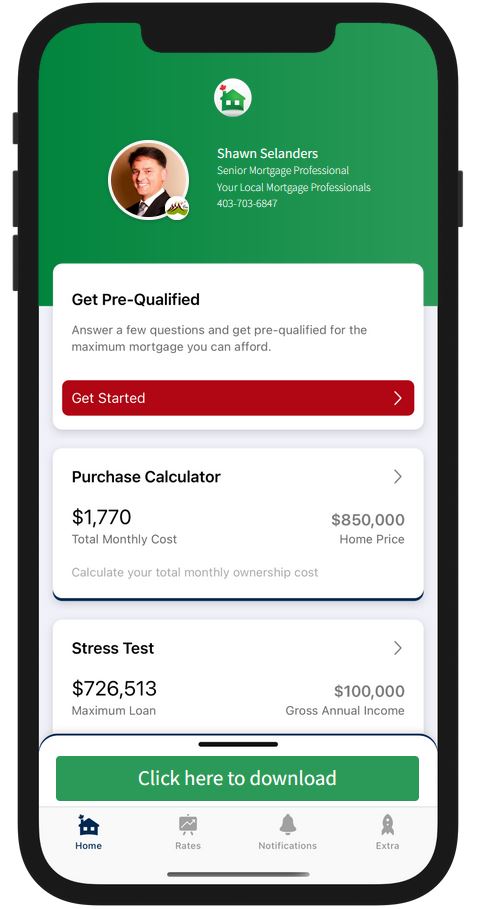
Affordability calculators, real-time rates, and the ability to start your application — right from your phone.


Explore My Mortgage Guides
Shawn Selanders — RECA-licensed mortgage broker
Your Local Mortgage Professionals — Independent Mortgage Professional
Serving Calgary, Okotoks, High River, Diamond Valley, Foothills County, and all of Alberta since 1999
This page is for informational purposes only and does not constitute financial or immigration advice. Mortgage approval is subject to lender criteria and conditions. Newcomer program eligibility, down payment requirements, and documentation requirements vary by lender and insurer. The Prohibition on the Purchase of Residential Property by Non-Canadians Act may restrict some non-residents from purchasing property. Always confirm your eligibility with a licensed mortgage professional and immigration advisor. O.A.C. E.&O.E.
📊 Run the Numbers Yourself
Use my free mortgage calculators to estimate payments, closing costs, affordability, and more — before you talk to any lender.
Open Mortgage Calculators →