
Mortgage Renewal in Alberta — The Complete 2026 Guide
Written by Shawn Selanders | RECA-Licensed Mortgage Broker | 25+ Years Experience | Updated February 2026
If you got a letter in the mail from your bank about your mortgage renewal — do not sign it yet.
That letter is your bank's opening offer. It is almost never the best rate available. A 10-minute phone call to an independent broker could save you thousands of dollars over your next term — and it typically costs you nothing.
This page will show you exactly why, how the renewal process works, what your options are, and what to watch out for in 2026.
🚨 The 2026 Renewal Wave Is Here
According to CMHC, approximately 1.15 million Canadian mortgages will renew in 2026, with another 940,000 in 2027. Many of these were locked in during 2020–2021 when rates were at historic lows (some as low as 1.74%).
If you're one of them, your next rate will almost certainly be higher. But how much higher depends on whether you accept your bank's first offer or shop the market. That's where I come in.

Renewals Are My Bread and Butter
I'm Shawn Selanders — an independent mortgage broker in Alberta since 1999. I've handled hundreds of renewals. Every single time, I see the same thing: the bank's renewal letter offers a rate that's higher than what the market is actually giving.
Banks count on the fact that most people will sign the letter out of convenience. Every year, thousands of Canadians sign their renewal letter without shopping around — leaving better rates and terms on the table. That's a lot of money left on the table.
My job is to make sure you don't leave money on the table. I shop 20+ lenders, compare the options, and tell you — in plain language — what your best move is.
What's on This Page
- What Is a Mortgage Renewal?
- The 2026 Renewal Landscape — What You're Facing
- Why You Should Never Just Sign the Renewal Letter
- The 120-Day Advantage — Start Early
- Stay or Switch? How to Decide
- The Stress Test Exemption — Big News for 2026
- Fixed vs. Variable in 2026 — What Makes Sense?
- Choosing Your Term Length
- Breaking Your Mortgage Early — Penalty Math
- Rate Isn't Everything — Features That Matter
- Dealing With Payment Shock
- The Renewal Process — Step by Step (With Me)
- Your 120-Day Renewal Checklist
- Real-World Examples — The Math
- Frequently Asked Questions
- Talk to Shawn — Free Renewal Review
1. What Is a Mortgage Renewal?
When you first get a mortgage, you choose a term — the length of time your interest rate and conditions are locked in. In Canada, the most popular term is 5 years.
When that term ends, your mortgage doesn't disappear. You still owe the remaining balance. A mortgage renewal is simply the process of signing a new agreement for the next term — with a new rate, and potentially new conditions.
Think of it like a cell phone contract: the plan you signed up for is expiring, and now you get to renegotiate. The question is whether you just accept what they offer — or shop around for something better.
Key Terms — Quick Reference
- Term: The length of time your rate is locked in (e.g., 5 years). At the end of each term, you renew.
- Amortization: The total time to pay off the entire mortgage (e.g., 25 years). This continues across multiple terms.
- Renewal: Signing a new agreement for the next term — new rate, potentially new lender.
- Refinance: Different from renewal. A refinance changes the mortgage amount or amortization. A renewal keeps the same balance and remaining amortization.
- Switch / Transfer: Moving your mortgage to a different lender at renewal — often at no cost to you.
- Rate hold: Locking in a rate for up to 120 days before your renewal date. If rates go lower before you close, you get the lower rate.
2. The 2026 Renewal Landscape — What You're Facing
If your mortgage is renewing in 2026, here's the reality:
The Numbers (as of February 2026)
- Bank of Canada overnight rate: 2.25% — held steady since late 2025, down from 5% in mid-2023.
- Best 5-year fixed rates in Alberta: approximately 3.69%–4.0% (depending on lender, insured vs. uninsured).
- Best 5-year variable rates: approximately 3.35%–3.5%.
- Best 3-year fixed rates: approximately 3.59%–3.9%.
- 1.15 million Canadian mortgages are renewing in 2026.
- ~60% of mortgages renewing in 2025–2026 will face higher monthly payments than their current term.
- 85% of mortgages renewing in 2025–2026 were opened when the BoC rate was at or below 1%.
- Savings from switching: Borrowers can save an average of $13,800+ over their term by switching lenders vs. auto-renewing, according to Ratehub.ca.
Rates are approximate and change frequently. O.A.C. Call me for current rates that apply to your situation.
The silver lining: While rates are higher than the pandemic lows, they've come down significantly from the 2023 peak. The Bank of Canada dropped the overnight rate from 5.0% to 2.25% over the course of 2024–2025. If you locked in a 5-year term in 2021 at around 1.7–2.5%, yes, your rate will go up. But it's not the catastrophe some predicted. With the right strategy, you can manage this transition.
3. Why You Should Never Just Sign the Renewal Letter
Your bank is required by law to send you a renewal notice at least 21 days before your term ends. Most banks send it 30–60 days out.
That letter will include a rate and ask you to sign and return it. It's designed to be easy. That's the point.
Here's what your bank is counting on:
- Inertia: You're busy. You don't want the hassle of switching. You figure it's probably fine. This is exactly what they're banking on — literally.
- Loyalty assumption: You've been with them for years. They assume you'll stay. But loyalty doesn't get you a better rate — leverage does.
- The rate is rarely their best: The rate on that renewal letter is almost never the lowest rate available — even from your own bank. It's their "posted" or "standard" rate. The real rates require negotiation or a broker.
- No competition = no incentive: If you don't shop around, your bank has zero incentive to give you anything better. They already have your business.
What a 0.25% Difference Actually Costs You
On a $400,000 mortgage with 20 years remaining:
A rate of 4.25% = $2,464/month | A rate of 4.00% = $2,415/month
That's $49/month. Over a 5-year term, that's $2,940 — just from a quarter-point difference.
A 0.50% difference? $5,880 over 5 years. A full 1%? Over $11,500. Still think signing the letter is "fine"?
4. The 120-Day Advantage — Start Early
Most lenders allow you to lock in a renewal rate up to 120 days (4 months) before your current term expires. Some lenders go even further.
This is one of the most powerful tools you have, and most homeowners don't use it. Here's why it matters:
How the 120-Day Rate Hold Works:
- I secure a rate commitment from a lender 120 days before your renewal date.
- That rate is locked in — if rates go up between now and your renewal, you're protected.
- If rates go down before your renewal date, you get the lower rate. You win either way.
- There's no cost for a rate hold. No obligation. You can still change your mind.
- It gives you time to compare, negotiate, and make a smart decision instead of a rushed one.
My recommendation: Call me 4 months before your renewal date. Not 4 weeks. Not when the letter arrives. Four months. That gives us time to get a rate hold in place, compare options, and make the right call without any pressure.
5. Stay or Switch? How to Decide
At renewal, you have three options:
Option A: Renew with Your Bank
Sign a new term with your current lender.
Easiest option — minimal paperwork.
Risk: You may not get the best rate.
Option B: Switch Lenders
Transfer your mortgage to a new lender.
Often free (new lender covers costs).
Benefit: Usually a better rate + cash bonuses.
Option C: Refinance
Change your mortgage amount or amortization.
Useful if you need cash or want to consolidate debt.
Note: This is different from a renewal — it involves re-qualifying.
When Staying Makes Sense:
- Your bank matches or beats the best available rate after you show them competing offers
- You have a collateral-charge mortgage that makes switching expensive (e.g., some TD and Tangerine mortgages)
- You need features only your current lender offers
- The rate difference is negligible (less than 0.10%) and you prefer convenience
When Switching Makes Sense:
- You can get a lower rate elsewhere (even 0.15–0.25% lower adds up fast)
- Your bank won't negotiate despite a competitive offer from another lender
- You want better prepayment privileges, portability, or other features
- The new lender is offering cash-back bonuses (some offer up to $4,000)
- You've had poor service and want a fresh start
The secret weapon: Even if you plan to stay, having a competing offer from another lender gives you negotiating leverage. Banks will often match or come close when they know you have an alternative. Let me get you that competing offer — it costs nothing and puts you in the driver's seat.
6. The Stress Test Exemption — Big News for 2026
This is one of the biggest changes in recent years, and it directly affects your renewal options.
The Old Rules:
If you wanted to switch lenders at renewal, you had to re-qualify under the mortgage stress test — meaning you had to prove you could afford payments at your contract rate + 2% (or 5.25%, whichever was higher). This blocked many homeowners from switching, even if another lender offered a better rate.
The New Rules (in effect now):
Borrowers with a mortgage at a federally regulated lender who do a straight switch (same mortgage amount, same amortization — no changes) are now exempt from the stress test when moving to a new lender. This means more homeowners can shop for better rates and actually switch without requalification barriers.
What this means for you: If your income has changed, your debt has increased, or you're self-employed — you may have been stuck with your current lender in the past. Now, with the stress test exemption for straight switches, you may have the freedom to move. This is a game-changer for a lot of Alberta homeowners. Let me check if this applies to your situation.
7. Fixed vs. Variable in 2026 — What Makes Sense?
This is the question I get asked most at renewal time. Here's where things stand.
Fixed Rate
- Your rate stays the same for the entire term
- Payments are predictable — no surprises
- Currently around 3.69%–4.0% for 5-year terms
- Tied to Government of Canada bond yields
- Penalties for breaking early can be steep (IRD calculation)
- Best for: people who want certainty and plan to stay the full term
Variable Rate
- Your rate fluctuates with the Bank of Canada's overnight rate
- Payments may change (or balance allocation shifts)
- Currently around 3.35%–3.5%
- Tied to BoC prime rate (currently 4.45%)
- Penalty for breaking early is usually just 3 months' interest (much cheaper)
- Best for: people comfortable with some uncertainty who want flexibility and lower break penalties
Where the BoC Is Headed in 2026:
The Bank of Canada has signalled that the overnight rate is currently at an appropriate level. Most economists expect the rate to hold steady through much of 2026, with possible cuts later in the year if the economy weakens.
Translation: Variable rates are unlikely to go much lower in the short term, but they're also unlikely to spike. Fixed rates are stable but could edge down slightly if bond yields continue to soften. Neither choice is clearly "wrong" — it depends on your risk tolerance and life plans.
My advice: I don't have a blanket answer. It depends on your situation. Are you selling in 2–3 years? Variable might save you money and avoid a big penalty. Are you staying put for 5 years and need budget certainty? Fixed gives you peace of mind. Let's talk through it.
8. Choosing Your Term Length
Most people default to 5 years. But shorter terms can make a lot of sense in 2026.
Term Options and When Each Makes Sense:
1-year fixed: You think rates will drop significantly soon. Or you're selling within a year. Penalty risk is minimal. Rates are typically higher than longer terms though.
2-year fixed: A middle-ground bet. If you believe rates will be lower in 2 years, this lets you renew again sooner at what could be a better rate. Currently competitive pricing.
3-year fixed: Often the sweet spot in uncertain markets. Rates are competitive (around 3.59%–3.9%), and you'll renew again in 2029 — giving you flexibility if the rate environment changes.
5-year fixed: The classic Canadian choice. Maximum certainty. You know exactly what your payment will be for 60 months. Best for long-term stability and budget planning.
5-year variable: Lowest starting rate right now. Your rate adjusts with BoC decisions. Cheapest penalty if you need to break early. Best for people with strong cash reserves and flexibility.
9. Breaking Your Mortgage Early — Penalty Math
Life happens. Divorce. Job relocation. Unexpected opportunity. If you need to break your mortgage before the term ends, there will be a penalty. Understanding this before you sign your renewal can save you a fortune.
Two Types of Penalties:
Variable rate penalty: Typically 3 months' interest. Example: $400K balance at 3.5% = approximately $3,500. Straightforward and relatively affordable.
Fixed rate penalty: The greater of 3 months' interest OR the Interest Rate Differential (IRD). The IRD can be enormous — sometimes $10,000 to $25,000+ — depending on how much rates have dropped since you locked in and how much time is left on your term.
The IRD penalty is one of the biggest hidden costs in Canadian mortgages, and it varies dramatically by lender. Some lenders use a "fair" IRD calculation. Others (especially the big banks) use a formula that produces much higher penalties.
Why this matters at renewal: If there's any chance you'll sell, refinance, or break your mortgage before the end of your next term, the lender's penalty structure should weigh heavily in your decision. I can show you exactly how each lender calculates their penalty so you can compare apples to apples — not just the rate.
10. Rate Isn't Everything — Features That Matter
The lowest rate doesn't always mean the best mortgage. Here's what else to look at:
- Prepayment privileges: Can you make lump-sum payments? How much per year? (10%, 15%, 20%?) Can you increase your regular payments? This can shave years off your mortgage.
- Portability: If you sell your current home and buy another, can you transfer (port) your mortgage to the new property? At what conditions? This avoids penalties.
- Blend-and-extend: If you need to break early, can the lender blend your current rate with a new rate and extend your term — instead of charging a full penalty?
- Penalty calculation: How does the lender calculate the IRD penalty? Posted rate vs. discount rate? This single factor can mean a difference of $5,000 to $15,000 if you need to break.
- Collateral vs. standard charge: A collateral-charge mortgage (used by TD, Tangerine, and some others) registers your mortgage for more than you owe. This makes it harder (and more expensive) to switch lenders later.
- Skip-a-payment: Some lenders allow you to skip a payment under certain circumstances. Useful in emergencies.
11. Dealing With Payment Shock
If you locked in at 1.7%–2.5% five years ago and you're renewing at 3.7%–4.0%, your monthly payment is going up. Let's talk about how to manage that.
Strategies to Reduce Payment Shock:
- Make a lump-sum payment before renewal: If you have savings, reducing your principal before the new rate kicks in will lower your payments for the entire next term.
- Choose a shorter term: A 3-year fixed may have a lower rate than a 5-year fixed, reducing payments now while giving you a chance to renew again when rates may be even lower.
- Consider variable: The current variable rate (around 3.35%) is lower than most fixed options. If the BoC holds or cuts, your payments could be even lower.
- Extend your amortization (if refinancing): If you refinance instead of a straight renewal, you may be able to extend the amortization back to 25–30 years, lowering the monthly payment. Note: this increases total interest paid over the life of the mortgage.
- Consolidate debt: If you're carrying high-interest credit card or line of credit balances, refinancing at renewal to consolidate that debt into your mortgage could actually lower your total monthly outflow — even with a higher mortgage rate.
12. The Renewal Process — Step by Step (With Me)
Step 1: Call Me 120 Days Out (Free — 15 minutes)
Tell me your renewal date, current lender, rate, balance, and any life changes. I'll give you an immediate sense of what's available and whether staying or switching makes sense.
Step 2: I Lock In a Rate Hold
I secure the best available rate from 20+ lenders and lock it for up to 120 days. If rates drop before your renewal, you get the lower rate. If they go up, you're protected. No cost. No obligation.
Step 3: We Compare Options
I show you the options side by side: staying with your bank vs. switching. Not just rates — penalties, features, cash-back offers, prepayment privileges. The full picture.
Step 4: You Decide
I give you my recommendation, but the decision is yours. If you decide to switch, I handle the entire process — application, documentation, lender communication. If you decide to stay, you now have leverage to negotiate with your bank.
Step 5: Seamless Transition
If you're switching, the new lender handles the transfer. Your old mortgage is discharged, the new one is registered, and your payments continue without interruption. Most of the time, you don't even notice the switch happened.
13. Your 120-Day Renewal Checklist
Print this. Stick it on your fridge. Follow it.
✅ 120 Days Before Renewal:
- ☐ Find your renewal date (check your mortgage statement or call your lender)
- ☐ Call Shawn (403-703-6847) for a free renewal review
- ☐ Lock in a rate hold — costs nothing, protects everything
✅ 90 Days Before Renewal:
- ☐ Review competing offers (I'll prepare these for you)
- ☐ Decide: stay, switch, or refinance?
- ☐ If switching — start the application process
✅ 60 Days Before Renewal:
- ☐ If staying — negotiate with your bank using the competing offer
- ☐ If switching — submit required documents
- ☐ Consider making a lump-sum payment to reduce your balance
✅ 30 Days Before Renewal:
- ☐ Sign your renewal or transfer documents
- ☐ Confirm your new payment amount and payment date
- ☐ Set a calendar reminder for 120 days before your NEXT renewal
✅ Renewal Day:
- ☐ Done. New term begins. You saved money. You're welcome. 😎
14. Real-World Examples — The Math
Let's look at three scenarios that represent what many Alberta homeowners are facing right now.
Scenario 1: The 2021 Pandemic-Rate Renewal
Original term (2021): $500,000 mortgage, 5-year fixed at 1.74%, 25-year amortization
Monthly payment (2021–2026): approximately $2,055
Remaining balance at renewal: approximately $420,000 (20 years remaining)
Bank's renewal offer: 4.49% (5-year fixed) → new payment: $2,597/month (+$542/month)
Broker-negotiated rate: 3.84% (5-year fixed) → new payment: $2,449/month (+$394/month)
Savings by using a broker: $148/month = $8,880 over the 5-year term.
Scenario 2: The Okotoks Family Looking to Reduce Payments
Situation: $350,000 remaining, renewing from 2.4% fixed. They also carry $30,000 in credit card debt at 20% interest ($500/month minimum).
Option A — Straight renewal at 3.89%: Mortgage payment goes from $1,576 to $1,843. Plus $500/month credit cards. Total: $2,343/month.
Option B — Refinance to $380,000 at 3.89%, consolidate debt, extend amortization to 25 years: New mortgage payment: $1,990/month. Credit card payments eliminated.
Monthly savings: $353/month. Plus they're now paying 3.89% on that debt instead of 20%.
Scenario 3: The Calgary Pre-Retiree Exploring Options
Situation: $180,000 remaining, 62 years old, retiring in 2 years. Renewing from 2.1% fixed.
Option A — 5-year fixed at 3.84%: Payment: $1,147/month. But if they retire and sell in 3 years, IRD penalty could be $4,000–$8,000.
Option B — 3-year fixed at 3.69%: Payment: $1,134/month. Term aligns with retirement plans. No penalty when they sell at maturity.
Option C — Variable at 3.35%: Payment: $1,102/month. If they sell early, penalty is only 3 months' interest (~$1,500 vs. $4,000–$8,000).
The right answer depends on their timeline, not just the rate.
All examples are illustrative only. Actual rates, payments, and penalties will vary. O.A.C.
15. Frequently Asked Questions
Q: Does it cost anything to use a mortgage broker for my renewal?
A: No. My service is completely free to you. The lender pays the broker fee. There is no charge for the consultation, the rate comparison, or the application — whether you end up switching or staying.
Q: Will switching lenders hurt my credit score?
A: A new mortgage application may result in a minor credit inquiry, which typically has a small, temporary effect on your score. In the context of a mortgage renewal (especially a straight switch), the impact is negligible and recovers quickly.
Q: What if my bank won't let me switch?
A: If you're at the end of your term (maturity date), you can switch to any lender without penalty. If you're trying to switch mid-term, there will be a penalty. At renewal, switching is your right — no lender can refuse to discharge your mortgage at maturity.
Q: What happens if I don't renew before my maturity date?
A: Your lender will typically roll you into an open mortgage at their posted rate — which is almost always much higher. You can still renew or switch at that point, but you'll be paying a premium in the interim. Don't let this happen. Start early.
Q: Can I switch lenders if I have a HELOC attached to my mortgage?
A: It depends on the structure. If your mortgage is registered as a collateral charge (which many HELOCs require), switching may involve additional costs. This is something I can evaluate for you — sometimes it's still worth switching despite the costs, and sometimes it's not.
Q: I'm self-employed. Can I still switch lenders at renewal?
A: Yes — and this is where the new stress test exemption is huge. If you're doing a straight switch (same balance, same amortization), you may not need to re-qualify at all, regardless of your income type. This has opened up options for self-employed borrowers that didn't exist before.
Q: My income has dropped since I first got my mortgage. Can I still renew?
A: Yes. If you renew with your current lender, there's typically no income verification required — they already have your mortgage. If you want to switch lenders, the new stress test exemption may allow you to transfer without requalifying, as long as the mortgage amount and amortization stay the same.
Q: Should I wait for rates to drop before I renew?
A: That's the wrong question. The right question is: "Should I lock in a rate hold now and also benefit if rates drop?" The 120-day rate hold gives you both — protection if rates rise, and the lower rate if they fall. You don't need to predict the future. You need to protect both directions.
Q: Is it worth switching for just 0.10% or 0.15%?
A: Maybe, maybe not. On a $300,000 mortgage, 0.15% saves about $22/month — or $1,320 over 5 years. If the switch is free (and it usually is), that's found money. But if you have a collateral charge mortgage or the paperwork hassle isn't worth it to you, staying might make more sense. I'll give you the real numbers so you can decide.
16. Talk to Shawn — Free Renewal Review
Your mortgage renewal is the single best opportunity to save money on your home — and it comes around every few years. Don't waste it.
Here's what I'll do for you in our first call:
- Review your current mortgage terms and rate
- Tell you what the best available rates are today — from 20+ lenders
- Calculate exactly how much you'd save by switching vs. staying
- Lock in a rate hold to protect you while we figure out the best plan
- Explain your fixed vs. variable and term options in plain language
- Identify if refinancing or debt consolidation could help your situation
Content last reviewed: March 2026. Mortgage rules and rates change frequently — contact Shawn for current information.
Don't Sign That Letter. Call Me First.
15 minutes. No cost. No obligation. I'll tell you if your bank's offer is fair — and if it's not, I'll show you what is.
Want to keep this information?
📥 Download the Free Guide (PDF)Call/Text: 403-703-6847
Email: Shawn@ShawnSelanders.ca
Office: 614 High View Park NW, High River, AB T1V 1E5
Hours: Monday to Friday: 9:00 – 7:00 | Saturday & Sunday: 12:00 – 5:00
Serving mortgage renewal clients across Alberta, including:
📊 Check Your Credit Score For Free Before Your Renewal
Know where you stand. Free, fast, and it won't hurt your score.
Click For a Free Credit Check📱 Download My Mortgage App — Compare Rates in Your Own Time
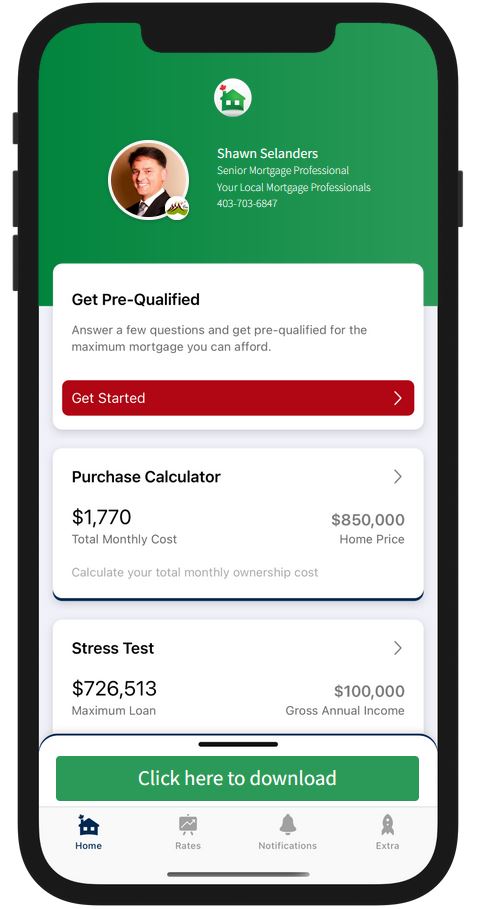
Access real-time rates from 20+ lenders, stress test tools, mortgage calculators, and side-by-side comparisons — right on your phone.


More on My Website
Shawn Selanders — RECA-licensed mortgage broker
Your Local Mortgage Professionals — Independent Mortgage Professional
Serving Calgary, Okotoks, High River, and all of Alberta since 1999
This page is for informational purposes only and does not constitute financial advice. Rates, terms, and products are subject to change and are subject to lender approval. O.A.C. E.&O.E.
📊 Run the Numbers Yourself
Use my free mortgage calculators to estimate payments, closing costs, affordability, and more — before you talk to any lender.
Open Mortgage Calculators →