
Investment Property Mortgage Alberta — Rental Properties, Multi-Units & More
Written by Shawn Selanders | RECA-Licensed Mortgage Broker | 25+ Years Experience | Updated February 2026
Investment property financing has different rules than your home mortgage. Different down payment. Different qualification. Different rates. And as of 2026, new OSFI regulations that make it even more important to work with a broker.
Whether you're buying your first rental property or adding to an existing portfolio, this guide covers exactly how investment property mortgages work in Alberta — the rules, the math, and the strategy that most bank advisors won't walk you through.
I've been helping Alberta investors finance rental properties for over 25 years. I know which lenders offer the best investment property programs, how to maximize rental income in your qualification, and how to structure your file for approval — even with the new 2026 rules.

Why Investors Use a Broker
Banks apply their own rules to investment properties — and they're often more restrictive than necessary. Some only count 50% of rental income. Some add rate premiums. Some won't finance a second rental at all.
I compare 20+ lenders and know exactly which ones offer the most investor-friendly qualification: higher rental income offsets, lower premiums, flexible debt ratio calculations, and programs for portfolio investors.
My service is free to you. The lender pays my fee — even on investment properties.
What's on This Page
- Investment Property Mortgage Rules in Canada
- Down Payment Requirements
- How Rental Income Helps You Qualify
- 2026 OSFI Rule Changes — What Investors Need to Know
- Types of Investment Properties
- Interest Rates on Investment Properties
- Running the Numbers — A Real Example
- 5 Mistakes Real Estate Investors Make
- Frequently Asked Questions
- Talk to Shawn — Free Strategy Call
1. Investment Property Mortgage Rules in Canada
If you're not going to live in the property, the mortgage rules change significantly. Here's what's different from your primary residence:
| Primary Residence | Investment Property | |
|---|---|---|
| Down payment | As low as 5% | 20% minimum |
| CMHC insurance | Available (under $1.5M) | Not available (non-owner-occupied) |
| Stress test | Yes (rate + 2%) | Yes (rate + 2%) |
| Interest rate | Best available | Typically 0.10%–0.25% higher |
| Amortization | Up to 30 years | Up to 30 years (with 20%+ down) |
| GDS / TDS ratios | 39% / 44% typical | 39% / 44% (rental income can help) |
The exception — owner-occupied multi-unit: If you buy a duplex, triplex, or fourplex and live in one unit, you may qualify with as little as 5% down and CMHC insurance. This is the most powerful entry point for new investors. More on this in Section 5.
2. Down Payment Requirements
| Property Type | Min. Down | Example ($500K Property) |
|---|---|---|
| Non-owner-occupied (1 unit) | 20% | $100,000 |
| Non-owner-occupied (2-4 units) | 20% | $100,000 |
| Owner-occupied duplex | 5% | $25,000 |
| Owner-occupied triplex/fourplex | 10% | $50,000 |
| 5+ units (commercial) | 25%+ | Commercial financing — different rules entirely |
Where Does the Down Payment Come From?
Savings: Most common. Personal savings, TFSAs, non-registered investments.
HELOC from your primary residence: Very popular. Use the equity in your home as the down payment for an investment property. Legal and commonly done.
Gift: Family gifts are accepted by most lenders — even for investment properties. Gift letter required.
Not allowed: Borrowed down payment from an unsecured source (personal loan, credit card) — lenders will flag this and it counts against your debt ratios.
3. How Rental Income Helps You Qualify
The biggest advantage of investment properties is that the rental income can be used to help you qualify for the mortgage. But how lenders count that income varies — a lot.
How Different Lenders Count Rental Income:
- Rental offset method (most common): The lender takes 50%–80% of the gross rental income and offsets it against the property's expenses (mortgage payment, taxes, heat). If the offset covers the costs, it doesn't count against your debt ratios.
- Add-back method: Some lenders add a portion of the rental income (typically 50%–100%) directly to your qualifying income. This increases your borrowing power.
- The difference is massive: A lender using the add-back method at 80% of rent can qualify you for significantly more than one using a 50% rental offset. This is where broker access matters — I know which lenders use which method and I match your file accordingly.
Example — Rental Income Qualification:
You're buying a rental property for $450,000. Expected rent: $2,200/month.
Lender A (50% rental offset): Counts $1,100/month toward the property costs. Tighter qualification.
Lender B (80% add-back): Adds $1,760/month to your qualifying income. Much stronger qualification.
Same property, same borrower, same rent — but Lender B qualifies you for more because of how they count the income. This is why investors need a broker.
4. 2026 OSFI Rule Changes — What Investors Need to Know
In 2026, Canada's banking regulator (OSFI) finalized significant changes that directly affect investment property financing:
Key 2026 Changes:
- No double-counting rental income: If rental income from a property is used to qualify for that property's mortgage, it cannot be reused to qualify for another mortgage. This limits portfolio expansion.
- Employment income allocation: Your employment income used for one mortgage can't be counted again for another. Lenders must carefully allocate income across your entire portfolio.
- IPRRE classification: When rental income accounts for more than 50% of the qualifying income on a mortgage, the loan is classified as "income-producing residential real estate" — which carries higher capital requirements for lenders. This may result in slightly higher rates or stricter qualification.
- More documentation: Banks will scrutinize income sources more closely. Expect more detailed verification of rental income, lease agreements, and income allocation across properties.
What This Means in Practice:
For first-time investors: Minimal impact. If you own your home and are buying one rental property, the new rules don't significantly change your qualification.
For portfolio investors (2+ rentals): Significant impact. Growing your portfolio is harder because you can't leverage the same income across multiple mortgages. Strategy and lender selection become critical.
My advice: Work with a broker who understands these rules. I can model your income allocation across your entire portfolio and find the lender combination that maximizes your borrowing capacity under the new framework.
5. Types of Investment Properties
Single-Family Rental (Non-Owner-Occupied)
Buy a house or condo and rent it out. 20% down. Easiest to understand. Works best when the rental income covers most or all of the carrying costs. Popular in Alberta's smaller cities and towns where purchase prices are lower relative to rents.
Owner-Occupied Duplex (The Best First Investment)
Buy a duplex, live in one side, rent the other. Down payment as low as 5%. CMHC-insurable. The rental income from the other unit helps you qualify AND pays a significant portion of your mortgage. This is the single most powerful entry point for new investors — you build equity, earn rental income, and live at a fraction of the cost.
Owner-Occupied Triplex or Fourplex
Same concept as a duplex, but with 2–3 rental units plus your own. 10% minimum down (owner-occupied). Multiple income streams from one property. Up to 4 units is still residential financing — once you hit 5 units, it becomes commercial with completely different (and harder) rules.
Non-Owner-Occupied Multi-Unit (2-4 Units)
You don't live there — all units are rented. 20% down. Multiple rental income streams help with qualification. These can be excellent cash-flow properties in Alberta's mid-size markets.
Short-Term Rental (Airbnb / VRBO)
Furnished rentals booked nightly/weekly. Can yield higher income than long-term rentals — but lender treatment varies. Some count projected STR income, many don't. More management, more risk, and municipal regulations are tightening across Alberta. I'll advise on which lenders are comfortable with STR income.
5+ Units (Commercial)
Five or more units = commercial mortgage. Different lenders, different rules, higher down payment (25%+), higher rates, and qualification is based more on the property's income than your personal income. This is a different world — but if you're at this stage, call me and I can connect you with the right resources.
6. Interest Rates on Investment Properties
Investment property rates are typically 0.10%–0.25% higher than owner-occupied rates from the same lender. On some lenders, the premium is even lower. Here's why — and why it matters less than you think:
Why Rates Are Slightly Higher:
- Lenders view investment properties as slightly higher risk (you're more likely to walk away from a rental than your home in a downturn)
- No CMHC insurance means the lender carries more risk
- With 20%+ down, you're already in conventional financing territory — which typically carries a small premium over insured rates regardless
Don't obsess over the rate premium. The difference between 4.49% and 4.64% on a $400K mortgage is about $30/month. What matters far more is how the lender counts your rental income, what their prepayment policies are, and whether they'll approve your file in the first place. I optimize for the total package, not just the rate.
7. Running the Numbers — A Real Example
Here's a straightforward Alberta rental property scenario to show you how the math works:
The Property:
Purchase price: $420,000 (3-bedroom detached in a mid-sized Alberta town)
Down payment: $84,000 (20%)
Mortgage: $336,000
Rate: 4.59% (5-year fixed)
Amortization: 30 years
Monthly Costs:
Mortgage payment: $1,720
Property taxes: $275
Insurance: $125
Maintenance reserve (5%): $110
Vacancy reserve (5%): $110
Total monthly costs: $2,340
Monthly Income:
Rent: $2,200/month
Monthly cash flow: -$140 (slightly negative before equity paydown)
But Here's the Full Picture:
Monthly equity paydown: ~$580/month goes toward principal in year one (this increases every year). The tenant is paying down YOUR mortgage.
Annual appreciation: At even a conservative 3% annual growth, a $420,000 property gains ~$12,600 in value per year.
Tax deductions: Mortgage interest, property taxes, insurance, maintenance, and depreciation are all deductible against rental income. Consult your accountant for your specific situation.
Real annual return: Even with -$140/month cash flow, you're building $6,960/year in equity paydown + $12,600/year in appreciation = $19,560 in total annual wealth building on an $84,000 investment. That's a 23% return.
This is an example only. Actual returns depend on rent levels, property appreciation (not guaranteed), interest rates, expenses, and tax situation. Always consult an accountant and run your own numbers. I'll help you calculate the mortgage side of the equation before you commit.
8. 5 Mistakes Real Estate Investors Make
1. Not accounting for vacancy and maintenance. A property isn't rented 12 months a year every year. Budget 5% for vacancy and 5% for maintenance. Investors who ignore these costs get blindsided when the furnace dies or the tenant leaves mid-winter.
2. Only talking to their bank. Bank A counts 50% of rent. Bank B counts 80% and adds it to your income. Same property, same borrower — but Bank B qualifies you while Bank A declines. A broker compares 20+ lenders. Your bank compares zero.
3. Ignoring the mortgage features. A 0.10% lower rate doesn't matter if the lender charges a $15,000 penalty to break the mortgage early. Investment properties are often refinanced, sold, or restructured before the term ends. I make sure the prepayment terms, portability, and penalty structure suit an investor's needs — not just the rate.
4. Not getting pre-approved before making offers. In competitive Alberta markets, sellers want offers with confirmed financing. If you're scrambling to get approved after your offer is accepted, you risk losing the deal or accepting unfavourable mortgage terms. Pre-approval positions you to move fast. Pre-approval guide →
5. Not consulting a tax professional. Investment property has significant tax implications — rental income is taxable, capital gains apply when you sell, and depreciation recapture can surprise you. I handle the mortgage side. Get an accountant for the tax side BEFORE you buy.
9. Frequently Asked Questions
Q: Can I use the equity in my home as the down payment for an investment property?
A: Yes — this is one of the most common strategies. You can take out a HELOC (home equity line of credit) on your primary residence and use those funds as the down payment on a rental property. The HELOC payments will count against your debt ratios, so you need to qualify for both — but it's a legitimate and widely used approach.
Q: How many rental properties can I own?
A: There's no hard legal limit, but each additional property makes qualification more complex. Most A-lenders cap at 4–5 financed properties per borrower. Beyond that, you may need B-lenders or specialized portfolio lending. The 2026 OSFI income allocation rules make each additional property incrementally harder to finance.
Q: Do I need a property manager?
A: Not required, but recommended if the property is far from where you live or if you don't want to handle tenants, maintenance, and emergencies yourself. Property managers typically charge 8%–15% of gross rent. Factor this into your cash flow projections.
Q: What if I don't have rental income history yet?
A: For a property you're purchasing, lenders will use projected rental income based on the appraisal (the appraiser estimates fair market rent) or comparable rental listings in the area. You don't need an existing tenant or rental history to qualify — the projected income is sufficient for most lenders.
Q: Should I buy a condo or a house as a rental?
A: Both work. Condos have lower entry prices but condo fees reduce your cash flow and you have less control over the building. Houses give you more control and often better appreciation but cost more upfront. In Alberta, detached homes in smaller towns often provide the best cash flow relative to purchase price. I can run the numbers on specific properties for you.
Q: Can I refinance my investment property later?
A: Yes — up to 80% of the appraised value. This is a common strategy to pull out equity for a down payment on the next investment property. Just remember: breaking your current mortgage may trigger a penalty, so timing matters. Renewal guide →
Q: How much does it cost to use a broker for an investment property mortgage?
A: $0. The lender pays my fee — even on investment properties. Same service, same access to 20+ lenders, no cost to you.
10. Talk to Shawn — Free Strategy Call
Whether you're buying your first rental or expanding a portfolio, I'll tell you exactly what you qualify for, how the rental income affects your approval, and which lender gives you the best terms. 15 minutes. Free. No obligation.
Investment Property Financing — Done Right
25+ years helping Alberta investors build wealth through real estate. Free consultation.
Call/Text: 403-703-6847
Email: Shawn@ShawnSelanders.ca
Office: 614 High View Park NW, High River, AB T1V 1E5
Hours: Monday to Friday: 9:00 – 7:00 | Saturday & Sunday: 12:00 – 5:00
Helping investors across Alberta, including:
📊 Check Your Credit Score For Free
Know where you stand before we talk. Free, fast, and it won't affect your score.
Click For a Free Credit Check ↗📱 Download My Mortgage App
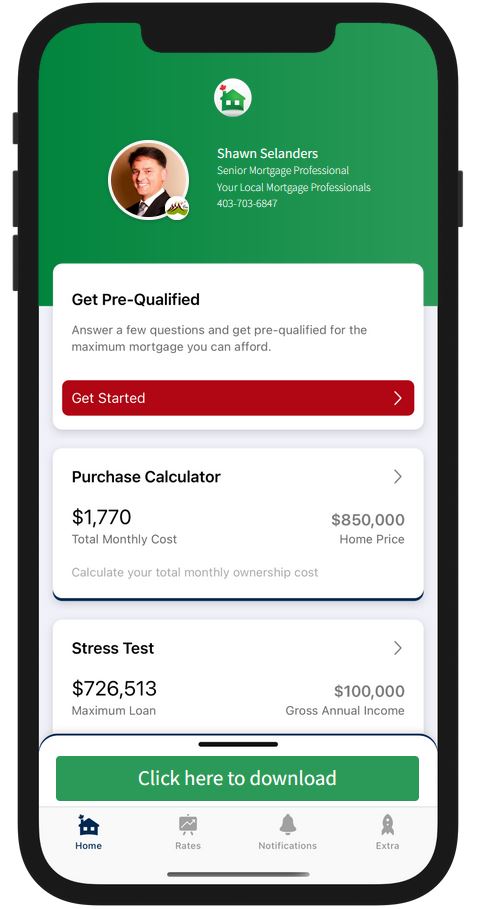
Affordability calculators, real-time rates, and the ability to start your application — right from your phone.


Explore My Mortgage Guides
Shawn Selanders — RECA-licensed mortgage broker
Your Local Mortgage Professionals — Independent Mortgage Professional
Serving Calgary, Okotoks, High River, Diamond Valley, Foothills County, and all of Alberta since 1999
This page is for informational purposes only and does not constitute financial or investment advice. Mortgage approval is subject to lender criteria and conditions. Investment returns are not guaranteed. Rental income projections, property appreciation, and tax implications are illustrative examples only. Consult a qualified accountant and financial advisor before making investment decisions. Regulatory rules (including OSFI guidelines) are subject to change. O.A.C. E.&O.E.
📊 Run the Numbers Yourself
Use my free mortgage calculators to estimate payments, closing costs, affordability, and more — before you talk to any lender.
Open Mortgage Calculators →