
Debt Consolidation Mortgage in Alberta — Use Your Home Equity to Eliminate High-Interest Debt
Written by Shawn Selanders | RECA-Licensed Mortgage Broker | 25+ Years Experience | Updated February 2026
Credit cards at 19.99%. A car loan at 7%. A line of credit at 8.5%. A personal loan at 12%. You're making four payments a month to four different lenders — and barely putting a dent in the principal.
Meanwhile, you're sitting on a home worth hundreds of thousands of dollars with equity you could be using to wipe out that debt at a fraction of the interest rate.
A debt consolidation mortgage rolls your high-interest debts into your mortgage — one payment, one rate, dramatically lower interest. I've helped hundreds of Alberta homeowners do this. The math is almost always in your favour.
💰 The Math That Changes Everything
$50,000 in credit card debt at 19.99% = $833/month in interest alone
$50,000 added to your mortgage at 4.5% = $188/month in interest
That's a $645/month savings — or $7,740/year — on just the interest. Same debt. Dramatically different cost. And instead of four payments, you make one.

Why Talk to a Broker About Debt Consolidation?
Your bank will offer you their refinance product. Period. I compare 20+ lenders to find the lowest rate, lowest penalty to break your current mortgage, and the best terms for your situation. Sometimes the best solution isn't a full refinance — it might be a HELOC, a second mortgage, or even waiting until your renewal date.
I've been doing this since 1999. I'll tell you honestly whether debt consolidation makes sense for your situation — or whether there's a better option.
My service is free to you. The lender pays my fee.
What's on This Page
- What Is a Debt Consolidation Mortgage?
- The Real-Dollar Math — A Full Example
- 3 Ways to Consolidate Debt Using Your Home
- What You Need to Qualify
- The Penalty Question — Should You Break Your Mortgage Early?
- Which Debts Can You Consolidate?
- Pros and Cons — The Honest Truth
- When Consolidation Makes Sense (and When It Doesn't)
- The Process — How It Works With Me
- 5 Mistakes People Make With Debt Consolidation
- Frequently Asked Questions
- Get a Free Assessment — See Your Numbers
1. What Is a Debt Consolidation Mortgage?
A debt consolidation mortgage uses the equity in your home to pay off your other debts — credit cards, car loans, personal loans, lines of credit, even CRA tax debt — and rolls them into your mortgage at a much lower interest rate.
Instead of making multiple payments to multiple creditors at high interest rates, you make one payment at your mortgage rate.
The Key Concept: Home Equity
Your home equity is the difference between what your home is worth and what you owe on it.
Example: Your home is worth $550,000. Your mortgage balance is $350,000. Your equity is $200,000.
In Canada, you can refinance up to 80% of your home's appraised value. That means you could access up to $440,000 in total mortgage — which is $90,000 more than your current balance.
That $90,000 can be used to pay off high-interest debts. The debts disappear. Your total mortgage goes up. But your total monthly payments go way down — because you've replaced 12%–20% interest with 4%–5% interest.
2. The Real-Dollar Math — A Full Example
Let's look at a realistic Alberta scenario. Meet Karen and Mike.
Before Consolidation:
| Debt | Balance | Rate | Monthly Payment |
|---|---|---|---|
| Mortgage | $340,000 | 4.5% | $1,870 |
| Visa | $22,000 | 19.99% | $660 |
| Mastercard | $14,000 | 19.99% | $420 |
| Car Loan | $18,000 | 6.9% | $360 |
| Personal Line of Credit | $12,000 | 8.5% | $250 |
| TOTAL | $406,000 | — | $3,560/mo |
After Consolidation:
Home value: $550,000. Maximum refinance at 80% LTV: $440,000.
New mortgage: $406,000 (current mortgage + $66,000 in consumer debt) at 4.5%, 25-year amortization.
| Debt | Balance | Rate | Monthly Payment |
|---|---|---|---|
| New Mortgage (everything consolidated) | $406,000 | 4.5% | $2,235/mo |
The Result:
Monthly payments: $3,560 → $2,235 = savings of $1,325/month
Annual savings: $15,900
Credit cards, car loan, line of credit: GONE
Number of monthly payments: 5 → 1
The catch you need to know about: Your mortgage balance went up by $66,000 and you're now paying interest on that over a longer term. If you don't change your spending habits, you could end up right back where you started — but now with a bigger mortgage AND new credit card debt. I'll address this honestly in the Pros and Cons section.
📊 Worried About Your Credit Score?
Carrying debt doesn't always mean bad credit — and consolidating can actually help your score over time. Check where you stand right now for free. Takes 2 minutes, no impact to your score.
Check Your Score Free →3. Three Ways to Consolidate Debt Using Your Home
Option A: Mortgage Refinance
You break your current mortgage, take a new, larger mortgage, and use the extra funds to pay off your debts. Everything rolls into one payment.
Max LTV: 80% of your home's appraised value
Best for: Large amounts of debt ($30,000+), when you want to simplify to one single payment at the lowest possible rate
Pros: Lowest rate, one payment, fresh amortization
Cons: You'll likely pay a penalty to break your current mortgage (could be $3,000–$15,000+ depending on your lender and term). Legal fees apply (~$1,200–$2,000). This may be best timed with your renewal date to avoid the penalty entirely.
Option B: Home Equity Line of Credit (HELOC)
You set up a HELOC alongside your existing mortgage. You draw from the HELOC to pay off your debts, and you make interest-only (or interest + principal) payments on the HELOC.
Max LTV: 65% of your home's appraised value (HELOC portion) — combined mortgage + HELOC cannot exceed 80%
Best for: Moderate debt amounts, when you want revolving access to equity, or when you don't want to break your current mortgage
Pros: Flexible — you can draw, repay, and redraw. May not require breaking your current mortgage. Interest-only payments available.
Cons: HELOC rates are typically prime + 0.5% to prime + 1.0% (variable), so higher than a fixed mortgage rate. Interest-only payments mean the principal doesn't go down unless you deliberately pay more. Requires discipline.
Option C: Second Mortgage
You take out a second mortgage behind your existing first mortgage. The second mortgage provides funds to pay off your debts without touching your first mortgage.
Max LTV: Up to 80% with A/B lenders, up to 85%+ with private lenders
Best for: When you can't or don't want to break your first mortgage (e.g., you have a great rate locked in), or when you don't have enough equity for a full refinance
Pros: Keeps your existing mortgage intact. Can access equity without triggering a penalty. Available even with lower credit scores (through private lenders).
Cons: Higher interest rates than a first mortgage (B-lender seconds typically 6%–9%, private seconds 8%–14%). Lender fees often apply (1%–3% of the loan amount). Should be used strategically as a short-term solution.
Which option is right? That depends on your mortgage rate, your penalty, your equity, your credit score, and how much debt you're consolidating. I'll run all three scenarios for you and show you the actual numbers side by side. Free. No obligation.
4. What You Need to Qualify
For an A-Lender Refinance (Best Rates):
- At least 20% equity in your home after the refinance (maximum 80% LTV)
- Credit score of 640+ (680+ for the best rates)
- Verifiable income that supports the new, higher mortgage payment
- Debt service ratios within limits — GDS ≤ 39%, TDS ≤ 44% (post-consolidation)
- Property appraisal confirming your home's current market value
Don't Meet Those Requirements? You Still Have Options:
- Credit score 550–640: B-lenders and alternative lenders offer debt consolidation refinances at slightly higher rates. Still far better than credit card interest.
- Credit below 550 or consumer proposal/bankruptcy: Private lenders can provide equity-based lending with less emphasis on credit score. Higher rates (8%–14%) and lender fees apply, but it can stop the bleeding and give you a path to rebuild.
- Less than 20% equity: A second mortgage or private lending may still be available depending on your overall financial picture.
5. The Penalty Question — Should You Break Your Mortgage Early?
If you refinance before your mortgage term is up, you'll likely pay a prepayment penalty. This is the number one concern people have — and it should be. But the math often still works heavily in your favour.
How Penalties Are Calculated:
Variable-rate mortgage: Penalty is typically 3 months' interest. On a $350,000 balance at 4.5%, that's roughly $3,900. Very manageable.
Fixed-rate mortgage: Penalty is the greater of 3 months' interest OR the Interest Rate Differential (IRD). The IRD can be significantly higher — anywhere from $5,000 to $20,000+ depending on the lender, the rate difference, and time remaining.
Important: Big bank IRD penalties are typically much more expensive than monoline lender penalties. This is one reason I often recommend monoline lenders for purchases — their penalties at renewal or refinance time are far more reasonable.
The Penalty Math Example:
Karen and Mike's penalty to break their mortgage: $7,500
Monthly savings from consolidation: $1,325/month
Time to recover the penalty: 5.7 months
After that, every month is pure savings. Over the remaining 3 years of their term, they save approximately $40,000 even after the penalty. The penalty pays for itself many times over.
Smart timing: If your renewal is coming up within 6–12 months, it may make more sense to wait and consolidate at renewal — no penalty, no legal fees, just a new mortgage that includes your debts. I'll run the comparison and tell you honestly which timing saves you the most money.
6. Which Debts Can You Consolidate?
- ✅ Credit cards (Visa, Mastercard, Amex, store cards)
- ✅ Personal lines of credit
- ✅ Car loans
- ✅ Personal loans
- ✅ Student loans
- ✅ Payday loans
- ✅ CRA tax debt (with conditions)
- ✅ Consumer proposal payouts
- ✅ Collection accounts
- ✅ Private loan balances
In many cases, the lender will pay your creditors directly as a condition of the mortgage approval — so you don't have to manage the payouts yourself. The debts are cleared, the accounts are closed (or reduced to zero), and you move forward with one payment.
7. Pros and Cons — The Honest Truth
✅ The Pros
- Dramatically lower interest rate — mortgage rates vs. credit card rates
- Lower monthly payments — often hundreds or thousands less per month
- One single payment — simpler, less stressful, fewer missed payments
- Improved cash flow — extra money each month for savings, investing, or paying down your mortgage faster
- Credit score recovery — paid-off debts improve your utilization ratio and credit profile
⚠️ The Cons
- Your mortgage balance increases — you're not eliminating the debt, you're restructuring it
- You'll pay more total interest over time — spreading debt over 25 years means more interest overall, even at a lower rate
- Penalty to break your mortgage — can be significant with fixed-rate mortgages at big banks
- Legal and appraisal fees — typically $1,500–$2,500 total
- Risk of re-accumulating debt — if you run up your credit cards again after consolidating, you'll be in a worse position than before
The "More Total Interest" Concern — Let's Address It Directly
Critics point out that spreading $50,000 over 25 years at 4.5% costs more in total interest than paying it off at 19.99% over 3 years. That's technically true — if you actually make those aggressive 3-year payments.
But most people carrying $50,000 in credit card debt aren't paying it off in 3 years. They're making minimum payments and drowning. The real comparison isn't "3 years at 20% vs. 25 years at 4.5%." The real comparison is "struggling indefinitely at 20% vs. a structured repayment at 4.5%."
And here's the key: once you consolidate and free up $1,325/month in cash flow, you can redirect some of that toward extra mortgage payments — paying off the consolidated amount in 5–7 years instead of 25. That's the winning strategy.
8. When Consolidation Makes Sense (and When It Doesn't)
✅ It Makes Sense When:
- You have $20,000+ in high-interest consumer debt
- Your home has at least 20% equity
- You're making multiple payments to multiple creditors and struggling to keep up
- The interest savings clearly outweigh the penalty and fees
- You're committed to not running up new debt after consolidating
- Your mortgage renewal is approaching (zero penalty = maximum benefit)
❌ It May NOT Make Sense When:
- Your consumer debt is small (under $10,000) — the fees may not justify it
- You don't have enough home equity
- The prepayment penalty is extremely high and your renewal is years away
- You haven't addressed the spending habits that created the debt in the first place
- You're considering a consumer proposal or bankruptcy — in which case, talk to a Licensed Insolvency Trustee first
9. The Process — How It Works With Me
Step 1: Free Assessment (15 Minutes)
Call or text me. I'll ask about your debts (balances, interest rates, monthly payments), your current mortgage details, and your home's approximate value. Within minutes, I can tell you whether consolidation makes sense.
Step 2: I Run the Full Comparison
I calculate your penalty, compare refinance vs. HELOC vs. second mortgage vs. waiting for renewal, and show you the real numbers — monthly savings, total cost, and payback period on any penalties or fees.
Step 3: I Shop 30+ Lenders
I find the best rate and terms for your refinance from banks, credit unions, monoline lenders, and alternative lenders. If you need a B-lender or private option, I have those too.
Step 4: The Lender Pays Off Your Debts
In most cases, the new lender pays your creditors directly as a condition of approval. Your credit cards, loans, and lines of credit get zeroed out. You're left with one mortgage payment.
Step 5: We Build a Plan to Stay Debt-Free
I'll show you how to redirect your freed-up cash flow toward extra mortgage payments — so you pay off the consolidated amount faster than your regular amortization. The goal isn't just to feel better today. It's to be truly debt-free sooner.
10. 5 Mistakes People Make With Debt Consolidation
1. Running up the credit cards again after consolidating. This is the #1 risk. You've freed up $1,325/month. If you use that to fund more spending, you'll end up with a bigger mortgage AND new credit card debt. Consolidation only works if the behaviour changes.
2. Not calculating the penalty before deciding. Some people assume the penalty is small, proceed with the refinance, and get hit with a $15,000+ IRD charge. I calculate your exact penalty before we make any decisions. No surprises.
3. Only considering their bank. Your bank will offer you their product at their rate. They won't tell you about the credit union with a lower rate, the monoline lender with better prepayment privileges, or the HELOC option that avoids breaking your mortgage entirely. A broker sees the whole market.
4. Not making extra payments after consolidation. The power of consolidation is the cash flow it frees up. If you take even half of your monthly savings and apply it as extra mortgage payments, you'll pay off the consolidated debt in years, not decades.
5. Waiting too long. Every month you carry $50,000 at 19.99%, you're losing $833 in interest. That's money gone — not reducing your balance, not building equity, just gone. If consolidation makes mathematical sense, every month you delay costs you real dollars.
11. Frequently Asked Questions
Q: Will consolidating debt into my mortgage hurt my credit score?
A: Initially, the refinance will show a credit inquiry and a new mortgage, which can cause a small, temporary dip. But once your credit cards and loans show as paid in full, your credit score typically improves significantly — often 50–100+ points — because your credit utilization drops to near zero.
Q: Can I consolidate debt if I have bad credit?
A: Yes — if you have equity in your home. B-lenders work with credit scores as low as 550. Private lenders focus primarily on equity, not credit score. The rates are higher than prime, but still dramatically lower than credit card rates. And the improved cash flow can help you rebuild your credit for a future refinance into better terms.
Q: Can I consolidate at mortgage renewal time without a penalty?
A: Yes — this is the ideal scenario. At renewal, you can refinance with a new lender, increase your mortgage to cover your debts, and pay zero penalty. If your renewal is coming up within the next year, this may be the smartest approach. I can lock in a rate hold now and have the consolidation ready to go on your renewal date.
Q: Does the lender actually pay off my debts directly?
A: In most cases, yes. As a condition of your refinance, the lender will require proof that the consolidated debts are paid out. They'll often issue cheques directly to your creditors from the mortgage proceeds. This protects both you and the lender.
Q: Can I consolidate my spouse's/partner's debts too?
A: Yes — if your spouse is on the mortgage or will be added to it. Both borrowers' debts and incomes are considered in the qualification. Even if only one spouse has the debt, consolidating it through the joint mortgage can make sense for the household's overall cash flow.
Q: How much does debt consolidation through a broker cost me?
A: My service is free. The lender pays my fee. You'll have standard refinance costs — legal fees (~$1,200–$2,000), appraisal (~$0–$500), and the prepayment penalty if breaking mid-term. These costs can often be rolled into the new mortgage so there's no out-of-pocket expense.
Q: What about a consumer proposal instead?
A: A consumer proposal is a legal process through a Licensed Insolvency Trustee that reduces your debt. It's a legitimate option for some people — but it stays on your credit report for 3 years after completion and makes future borrowing much more difficult. If you have equity in your home, a debt consolidation mortgage is almost always the better first choice. It preserves your credit and achieves a similar (often better) result.
12. Get a Free Assessment — See Your Numbers
You don't have to commit to anything. Call me, tell me your situation, and I'll tell you exactly how much you could save. If it makes sense, we move forward. If it doesn't, I'll tell you that too. 15 minutes. No cost. No pressure.
Stop Paying 20% When You Could Be Paying 4.5%
I'll calculate your penalty, your savings, and your options. Free assessment, no obligation.
Want to keep this information?
📥 Download the Free Guide (PDF)Call/Text: 403-703-6847
Email: Shawn@ShawnSelanders.ca
Office: 614 High View Park NW, High River, AB T1V 1E5
Hours: Monday to Friday: 9:00 – 7:00 | Saturday & Sunday: 12:00 – 5:00
Helping Alberta homeowners eliminate high-interest debt, including:
📊 Check Your Credit Score For Free
Know where you stand before we talk. Free, fast, and it won't affect your score.
Click For a Free Credit Check ↗📱 Download My Mortgage App
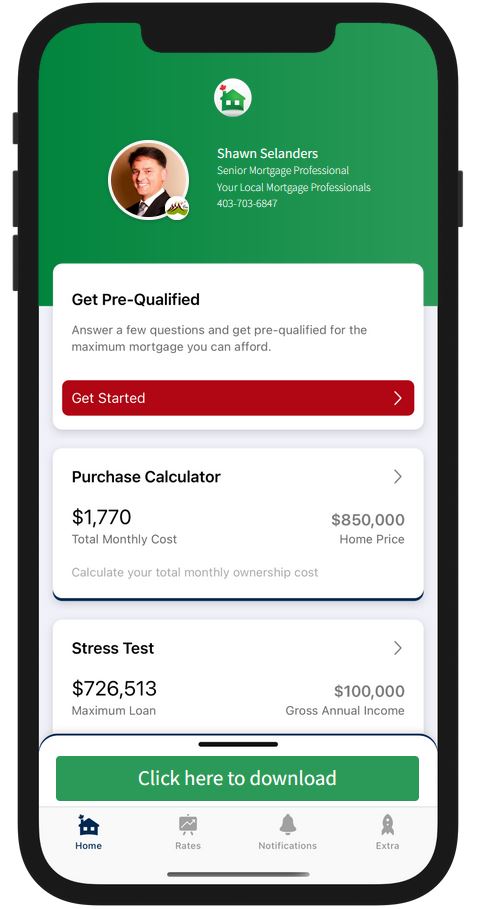
Affordability calculators, real-time rates, and the ability to start your application — right from your phone.


Related Guides on My Website
Shawn Selanders — RECA-licensed mortgage broker
Your Local Mortgage Professionals — Independent Mortgage Professional
Serving Calgary, Okotoks, High River, Diamond Valley, and all of Alberta since 1999
This page is for informational purposes only and does not constitute financial advice. Debt consolidation through mortgage refinancing involves increasing your mortgage balance and may result in paying more interest over the life of the loan. Qualification is subject to lender criteria. Rates, terms, and penalties vary by lender and product. Consult a licensed professional before making financial decisions. O.A.C. E.&O.E.
📊 Run the Numbers Yourself
Use my free mortgage calculators to estimate payments, closing costs, affordability, and more — before you talk to any lender.
Open Mortgage Calculators →