
Construction & Renovation Mortgage Alberta — Build, Renovate & Finance Your Project
Written by Shawn Selanders | RECA-Licensed Mortgage Broker | 25+ Years Experience | Updated February 2026
Building a new home or renovating an existing one? The financing works differently than a standard mortgage — and most banks won't explain the options clearly.
There are three distinct mortgage programs for construction and renovation projects in Canada: purchase plus improvements (roll renovation costs into your mortgage), construction draw mortgages (build a new home with staged funding), and refinancing for renovations (use your existing equity to fund improvements).
Each has different rules, different timelines, and different qualification requirements. This guide covers all three — so you can choose the right path before you hire a contractor or break ground.

Why Construction Financing Needs a Broker
Construction and renovation mortgages are more complex than standard purchases. Draw schedules, inspections, holdbacks, insurer worksheets, contractor documentation — it's a lot. And not every lender offers these programs.
I compare 20+ lenders and have handled construction draws, purchase plus improvements, and renovation refinances across Alberta for over 25 years. I know which lenders are easiest to work with and which programs fit your project.
My service is free to you. The lender pays my fee.
What's on This Page
- Which Program Do You Need?
- Purchase Plus Improvements — Buy and Renovate
- Construction Draw Mortgage — Build From the Ground Up
- Refinance for Renovations — Use Your Existing Equity
- Down Payment Requirements
- Alberta-Specific Considerations
- 5 Mistakes Builders and Renovators Make
- Frequently Asked Questions
- Talk to Shawn Before You Break Ground
1. Which Program Do You Need?
| Your Situation | The Program |
|---|---|
| Buying a home that needs renovations (kitchen, bathroom, flooring, roof, etc.) | Purchase Plus Improvements |
| Building a new home on vacant land (with a contractor or self-build) | Construction Draw Mortgage |
| Tearing down an existing home and rebuilding | Construction Draw Mortgage |
| Major renovation with structural changes to your current home | Refinance or Construction Draw |
| Cosmetic updates to your current home (new kitchen, basement finish, etc.) | Refinance or HELOC |
| Buying a pre-construction home from a builder | Standard Mortgage (completion) |
Not sure which one applies? Call me. A 15-minute conversation will clarify which program fits your project, what you need to prepare, and what the timeline looks like.
2. Purchase Plus Improvements — Buy and Renovate
This is the most popular option for homebuyers who find a home they love but want to make improvements right away. It lets you roll the renovation costs directly into your mortgage — one loan, one payment, at mortgage rates instead of credit card or line of credit rates.
How Purchase Plus Improvements Works:
1. You find a home and determine the renovations you want.
2. You get a contractor quote for the work before closing.
3. The lender calculates your mortgage based on the purchase price plus the renovation costs — up to the "as-improved" value of the home.
4. On closing, you receive the mortgage for the purchase price. The renovation funds are held back by the lawyer.
5. You complete the renovations (typically within 90–120 days, some lenders allow up to 365 days).
6. An appraiser confirms the work is done, and the remaining funds are released to you.
You pay only interest on the renovation holdback until it's released.
Key Rules:
- Insured (under 20% down): Up to 10% of the as-improved value of the home. As little as 5% down. Available through CMHC, Sagen, or Canada Guaranty.
- Conventional (20%+ down): Up to 20% of the purchase price (some lenders more). No mortgage insurance required.
- Renovations must be permanent: Kitchens, bathrooms, flooring, roofing, windows, basement finishing, structural repairs, decks. No appliances, no furniture, no landscaping (in most cases).
- Contractor quotes required: Detailed, itemized quotes submitted with your mortgage application.
- DIY is allowed by some lenders: But only material costs are covered — not your labour. And most lenders prefer licensed contractors.
Example — Purchase Plus Improvements:
Purchase price: $425,000
Renovation budget: $35,000 (new kitchen, flooring, bathroom update)
Total mortgage: $460,000 (minus your down payment)
As-improved value confirmed by appraisal: $470,000
You've instantly added $10,000 in equity AND have a home renovated to your taste — all financed at mortgage rates (~4.5%) instead of credit card rates (20%+).
3. Construction Draw Mortgage — Build From the Ground Up
If you're building a new home — whether with a general contractor or self-building — a construction draw mortgage releases funds in stages as construction progresses. This is fundamentally different from a standard mortgage.
How Construction Draws Work:
The lender approves a total mortgage amount based on the completed value of the home. Then, instead of advancing the full amount at once, funds are released at 4–5 milestone stages:
Draw 1: Land purchase + excavation and foundation complete (~15% of project)
Draw 2: Framing, roof, doors, and windows installed (~35% complete)
Draw 3: Electrical, plumbing, insulation, exterior finishing (~65% complete)
Draw 4: Interior finishing — drywall, flooring, cabinets, fixtures (~85% complete)
Draw 5 (Final): 100% complete — occupancy permit, final inspection
Before each draw, a lender-appointed inspector visits the site and confirms the milestone is met. You only pay interest on the amount drawn so far.
Three Types of Construction Mortgage:
- Builder/Contractor Build: You hire a general contractor who manages the entire project. Most straightforward for lenders. Requires a signed, fixed-price construction contract.
- Self-Build: You act as your own general contractor and hire individual trades. More complex. Lenders require proof you have the expertise, time, and cash reserves to carry the project between draws. In Alberta, you must purchase New Home Warranty at the outset.
- Completion (Pre-Built): You're buying a new home from a builder who handles all construction. You don't receive funds until the home is complete and you take possession. This is essentially a standard purchase mortgage — not a draw mortgage.
Critical Things to Understand:
- You don't get money in advance. Draws are released AFTER milestones are confirmed — not before. You need cash reserves to carry costs between draws.
- Holdbacks are required. Under Alberta's Builders' Lien Act, 10% of each payment to your contractor is held back. This protects you against liens from subcontractors. The holdback is released 45 days after construction is complete.
- Timeline matters. Most lenders expect construction to be completed within 12–15 months. If your project stalls, the lender may not release further draws.
- Interest-only payments during construction. You pay interest only on the drawn amount during the build phase. Once construction is complete, the mortgage converts to a standard mortgage with principal and interest payments.
- Not all lenders offer this. Construction draw mortgages are specialized products. Most credit unions and many smaller lenders don't offer them. This is where broker access matters.
4. Refinance for Renovations — Use Your Existing Equity
Already own your home and want to renovate? If you have equity, you can access it through refinancing or a HELOC. No new purchase required — you're simply borrowing against the value you've already built.
Refinance
Break your current mortgage (or wait for renewal) and take out a new, larger mortgage — up to 80% of your home's appraised value.
The difference between your old mortgage and the new one gives you cash for renovations.
Best for: Large renovation budgets ($50K+), when you also want a better rate or different term.
Watch for: Prepayment penalty if breaking mid-term.
HELOC (Home Equity Line of Credit)
A revolving credit line secured against your home — up to 65% of your home's value (combined with your mortgage, up to 80%).
Draw funds as needed, pay interest only on what you use. Flexible — pay it down, draw again.
Best for: Smaller renovations, phased projects, or when you want access to funds over time.
Watch for: Variable interest rate (higher than fixed mortgage rates). Interest-only minimums can extend repayment.
Example — Refinance for Renovations:
Current home value: $600,000
Current mortgage balance: $350,000
Maximum refinance (80% LTV): $480,000
Available for renovations: $130,000 ($480,000 - $350,000)
That's $130,000 at mortgage rates (~4.5%–5%) instead of personal loan rates (8%–12%) or credit card rates (20%+). And the renovations will likely increase your home's value beyond what you spent.
5. Down Payment Requirements
| Program | Min. Down Payment | Notes |
|---|---|---|
| Purchase Plus Improvements (insured) | 5% | 5% on first $500K, 10% on remainder. CMHC/Sagen/Canada Guaranty insured. |
| Purchase Plus Improvements (conventional) | 20% | Higher renovation limits (up to 20% of purchase price). |
| Construction Draw (contractor build, insured) | 5% | Insured through Sagen or Canada Guaranty. Must meet builder and warranty requirements. |
| Construction Draw (conventional) | 20–25% | Of the total project cost (land + construction). Higher for self-builds. |
| Self-Build | 25%+ | Lenders require proven expertise and substantial cash reserves between draws. |
| Refinance for Renovations | N/A | You need 20%+ equity remaining after the refinance (80% max LTV). |
Cash reserves matter. For construction draw mortgages, you need cash to carry costs between draws — paying your contractor, buying materials, covering inspections. The lender reimburses you AFTER milestones are confirmed, not before. Budget for this gap.
6. Alberta-Specific Considerations
New Home Warranty (Mandatory in Alberta)
Since February 2014, all new homes built in Alberta must be covered under an approved New Home Warranty program. This applies to contractor builds AND self-builds. Lenders require the warranty registration number as part of the construction mortgage approval. Major providers include the Alberta New Home Warranty Program and National Home Warranty.
Builders' Lien Act
Alberta's Builders' Lien Act requires a 10% holdback on all construction payments. This protects you against liens filed by unpaid subcontractors or suppliers. The holdback is released 45 days after substantial completion — or after a lien clearance period expires. Your lender will enforce this automatically on draw releases.
Building on Acreages or Rural Land
Building on rural property adds complexity: well and septic requirements, zoning confirmation (country residential vs. agricultural), road access, and power servicing must all be addressed. Fewer lenders finance construction on acreages. I specialize in rural Alberta properties and know which lenders handle this well. Acreage mortgage guide →
Building Permits and Municipal Requirements
Your lender will require confirmation that all necessary building permits are in place before the first draw. In Foothills County, Okotoks, High River, Calgary, and other Alberta municipalities, permit requirements and timelines vary. Make sure your contractor has permits secured before you expect your first advance.
7. 5 Mistakes Builders and Renovators Make
1. Not getting financing lined up FIRST. I get calls from people who've already bought land and hired a contractor — only to discover they can't get a construction mortgage for their specific project. Call me before you commit to anything. I'll tell you what's possible and what's not.
2. Underestimating cash requirements between draws. The lender doesn't pay you in advance. You need cash on hand to pay your contractor deposits, material orders, and early trades — then the lender reimburses at each milestone. If you run out of cash mid-build, the project stalls. Budget a detailed cash flow worksheet showing when money goes out and when draws come in.
3. Not including a contingency budget. Construction projects almost always cost more than quoted. Budget 10–15% above your contractor's quote for unexpected costs — foundation issues, material price increases, weather delays. Your lender won't increase the mortgage after it's approved, so overruns come out of your pocket.
4. Choosing a contractor without checking references. Your lender will want to see a signed construction contract from a reputable, licensed contractor. But beyond what the lender requires — do your own due diligence. Check Alberta Builders' Lien Act registrations, ask for references, visit completed projects, and confirm they carry proper insurance. A bad contractor can derail your build AND your mortgage.
5. Exceeding the renovation budget on a Purchase Plus Improvements mortgage. If your renovations cost more than the approved quote, the lender won't increase the holdback. You cover the overage yourself. Conversely, if you spend less than quoted, the unused portion goes directly to your mortgage principal — you can't pocket it. Get accurate quotes upfront and stick to the plan.
8. Frequently Asked Questions
Q: Can I do the renovation work myself?
A: Some lenders allow DIY work on a Purchase Plus Improvements mortgage, but only material costs are covered — not your labour. For construction draw mortgages, self-build is possible but requires significant documentation, proven expertise, and higher cash reserves. Most lenders prefer licensed contractors for all major work.
Q: How long do I have to complete the renovations?
A: For Purchase Plus Improvements: typically 90–120 days after closing, though some lenders allow up to 365 days. For construction draw mortgages: most lenders expect the home to be completed within 12–15 months of the first advance. I match you with a lender whose timeline fits your project.
Q: Can I buy vacant land with a mortgage?
A: Land-only mortgages are very limited — typically 25–50% down and few lenders participate. The better approach is a construction mortgage that finances both the land purchase and the build together. The first draw covers the land acquisition (usually 65–75% of the lot value), with subsequent draws funding construction. Acreage guide →
Q: What about adding a secondary suite or basement apartment?
A: Some lenders will finance the addition of a secondary suite through a refinance or Purchase Plus Improvements — but many won't. The suite must comply with local building codes and zoning bylaws. If the suite will generate rental income, some lenders can factor that into your qualification. I know which lenders are most flexible on this.
Q: Are construction mortgage rates higher?
A: Construction draw mortgage rates are sometimes slightly higher than standard purchase rates (0.10%–0.50%) due to the added complexity and risk. However, insured construction draw mortgages through Sagen or Canada Guaranty can offer competitive rates similar to standard insured mortgages. Purchase Plus Improvements rates are typically the same as regular purchase rates.
Q: Can I use Purchase Plus Improvements on an investment property?
A: The insured program (5% down) requires the property to be owner-occupied. However, conventional Purchase Plus Improvements (20% down) can work for investment properties with certain lenders. Investment property guide →
Q: How much does a broker cost for construction financing?
A: $0. The lender pays my fee — whether it's a Purchase Plus Improvements, construction draw, or refinance for renovations. Same service, same 30+ lender access, no cost to you.
9. Talk to Shawn Before You Break Ground
Whether you're buying a fixer-upper, building your dream home, or renovating the house you're in — call me first. 15 minutes is all it takes to know which program fits, what you need to prepare, and what to expect. Free. No obligation.
Construction & Renovation Financing — Done Right
25+ years financing builds and renovations across Alberta. Free consultation.
Call/Text: 403-703-6847
Email: Shawn@ShawnSelanders.ca
Office: 614 High View Park NW, High River, AB T1V 1E5
Hours: Monday to Friday: 9:00 – 7:00 | Saturday & Sunday: 12:00 – 5:00
Serving builders and renovators across Alberta:
📊 Check Your Credit Score For Free
Know where you stand before we talk. Free, fast, and it won't affect your score.
Click For a Free Credit Check ↗📱 Download My Mortgage App
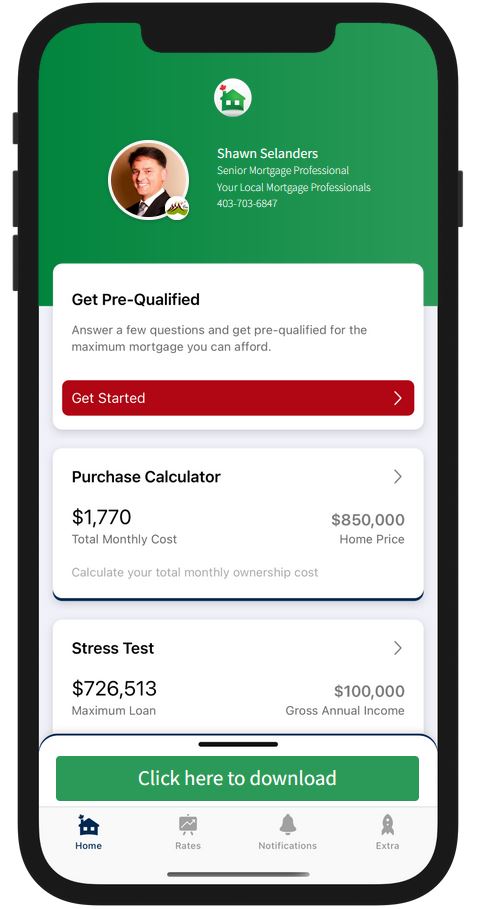
Affordability calculators, real-time rates, and the ability to start your application — right from your phone.


Explore My Mortgage Guides
Shawn Selanders — RECA-licensed mortgage broker
Your Local Mortgage Professionals — Independent Mortgage Professional
Serving Calgary, Okotoks, High River, Diamond Valley, Foothills County, and all of Alberta since 1999
This page is for informational purposes only and does not constitute financial advice. Mortgage approval is subject to lender criteria and conditions. Construction timelines, costs, and draw schedules are illustrative examples only. Actual terms vary by lender and project. Always obtain multiple contractor quotes and consult appropriate professionals before committing to construction or renovation projects. Alberta's Builders' Lien Act holdback requirements apply to all construction projects. O.A.C. E.&O.E.
📊 Run the Numbers Yourself
Use my free mortgage calculators to estimate payments, closing costs, affordability, and more — before you talk to any lender.
Open Mortgage Calculators →