
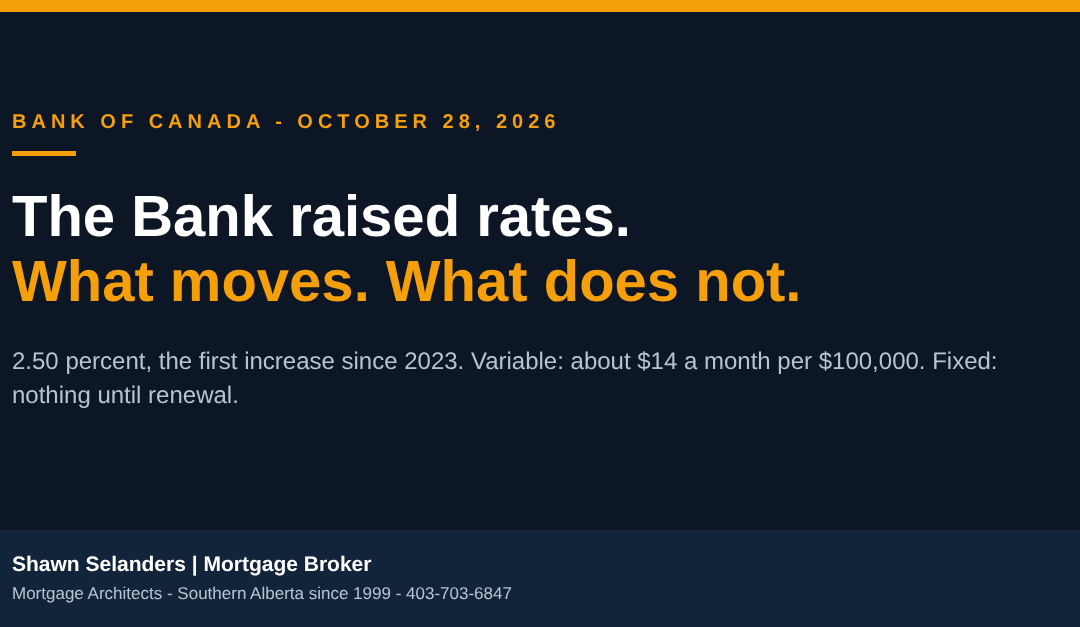
| ▶ | Raised to 2.50%. First increase since 2023. Prime moves from 4.45% to 4.70% on October 29. |
| ▶ | Variable rate: about $14 a month per $100,000. On $400,000, roughly $55. |
| ▶ | Fixed rate: nothing changes until renewal. Fixed follows bond yields, and they were already up this fall. |
| ▶ | The Bank says it may not be done. Next decision December 9. Your maturity date matters more than either. |
The Bank of Canada raised its target for the overnight rate by a quarter point to 2.50 percent on October 28, 2026. It is the first increase since 2023. Bank prime moves from 4.45 percent to 4.70 percent on October 29 - RBC and CIBC announced it the same afternoon. Here is what actually moves in your household, and what does not.
If you are on a variable rate, this one is about you. If you are on a fixed rate, it is not - not today. And if you were waiting for the Bank to make your renewal cheaper, the answer is in. It is going the other way.
Why the Bank raised
Inflation. The Bank said consumer prices have been running near 3 percent since April and could reach about 3.5 percent by year-end, mostly on energy. Take gasoline out and inflation was 2.2 percent in September, with the core measures close to 2 percent. The economy grew 3.3 percent in the second quarter and about 2 percent in the third, with unemployment around 6.5 percent. Growth with inflation above target is not the setup for cheaper money, and the Bank moved to stop high energy prices spreading into everything else.
The line that matters most for your mortgage: the Bank said there could be a need to increase the policy rate further, and that it will proceed carefully. That is not a promise of more increases. It is a warning that the next move is not automatically down.
I flagged this risk in September in why a rate increase was back on the table. The numbers I was watching then are the numbers that moved today.
What this means for a variable mortgage. Your rate is prime minus your discount. When prime moves up a quarter point, so does your rate. On a $400,000 mortgage over a 25-year amortization that is roughly $55 a month, about $14 per $100,000. Variable-payment holders see it on the next payment after their lender resets prime. Fixed-payment variable holders see the same payment, but less of it goes to principal, so the amortization quietly stretches.
What it means if you are renewing
Six in ten Canadian mortgages renew in 2025 or 2026. Bank of Canada staff estimated five-year fixed holders renewing in 2026 were looking at average payment increases around 20 percent before today. A quarter point on the overnight rate does not change that math directly, because fixed rates follow bond yields. But it changes the mood. When the Bank turns, lenders stop sharpening pencils.
So the plan does not change, it gets more urgent. Know your maturity date. Get organized six months out, not the four everybody else tells you. Take a rate hold now so you are protected while you look - select lenders will lock a rate a full year out, and a hold costs you nothing if rates fall. Since OSFI dropped the stress test on straight switches between federally regulated lenders, same balance and same amortization, moving your mortgage is simpler than it used to be. I worked a full example in what your payment will be after you renew, and the timing is on the renewals page.
What it means if you carry a line of credit
A home equity line of credit is priced off prime, so it goes up with it. On a $100,000 balance a quarter point is about $21 a month in interest. Not a crisis. But a HELOC balance that has been sitting there for years, plus credit cards at 20 percent, is the most expensive money in your house, and it just got a little more expensive.
If you have equity and a renewal coming, the renewal is the penalty-free window to fold that debt into one payment at a mortgage rate. Run the numbers on the debt consolidation calculator, then read HELOC or refinance for which door makes sense.
Fixed or variable from here
Here is the thing. One increase does not make variable a mistake. Variable holders have saved money for two years and most are still ahead of where a five-year fixed would have put them. But the reason to stay variable was that the next move was likely down. Today the Bank told you it might not be. If a second increase would hurt at your kitchen table, that is the conversation to have now, with your maturity date and your cash flow in front of you - not after December 9.
The move this month
Do not panic over a quarter point. Do go find your renewal date, check which kind of variable you have, and get a rate hold in place if your term ends in the next twelve months. The next scheduled announcement is December 9, 2026.
Want to know what this means for your file
Twenty minutes, no application, no credit pull. Tell me your rate, your maturity date and what is going on at home, and I will tell you whether to act or sit tight.
Call or text 403-703-6847Shawn Selanders, Mortgage Broker with Mortgage Architects, serving High River, Okotoks, Calgary, Foothills County and Southern Alberta since 1999, with access to 30+ lenders. Payment figures are illustrations only (25-year amortization, Canadian semi-annual compounding) and not an offer of credit. Prime rate changes are set by each lender and take effect on the date the lender announces. Rates and lender policies change without notice. All lending O.A.C. E.&O.E. Sources: Bank of Canada policy rate announcement, October 28, 2026; Bank of Canada Staff Analytical Note 2025-21, July 2025; OSFI, Minimum qualifying rate for uninsured mortgages.