
Your High River Mortgage Broker. Your Neighbour.
I’m not just serving High River — I live here. Serving Albertans since 1999. RECA licensed. 30+ lenders, one phone number, and a straight answer the first time you ask.
Call / Text 403-703-6847Apply Online
Your Neighbour. Your Broker. Your Advantage.
If you’re buying, renewing, or refinancing in High River, you want two things: the right mortgage — and a broker who will answer the phone and tell you the truth.
I review your options from your side of the desk. No bull. You get a straight answer to your questions the first time you ask.
When you call, you’re talking to your neighbour — not some Calgary broker who “also covers your area.” I’m focused on helping our community get the mortgages they deserve, without the bank runaround.
I didn’t move here for market opportunity. I moved here because after everything — caregiving, health scares, rebuilding — this felt like the right place to start the next chapter. Turns out it was.
Free Tool — Mortgage Payment Calculator
Price to payment — with the CMHC premium, the stress test, closing costs and the income needed, all in one place. No signup. It runs in your browser, and the number is yours, not mine. Want the real number for your actual situation? Text me the details at 403-703-6847 and I’ll run it against 30+ lenders.
In a Small Town, Your Bank Has One Answer. I Have 30+.
Here’s the thing about getting a mortgage in a small town. The branches on main street each sell one lender’s products. You walk in, and the best they can do is their best — which may or may not be the best for you. You’ll never know, because they can only show you their own shelf.
I’ve been doing this since 1999. Thousands of files — first homes, move-ups, renewals, refinances, self-employed deals the banks turned down, and reverse mortgages for people who just wanted to stay in the house they love. And I’m not tied to any one bank. I’m your access point to 30+ lenders and the hundreds of mortgage products between them — banks, credit unions, monoline lenders, alternative lenders, and options most people in town have never heard of.
You bring one application. I take it to the whole market. The lenders compete for your business — instead of you hoping the one branch in town happens to have your best deal.
That’s the part people miss: you don’t trade small-town trust for big-city choice. With me you get both — the neighbour who answers his own phone, plus the full arsenal a downtown Calgary broker would use, pointed straight at your file. Purchase, renewal, equity take-out or reverse mortgage, the move is the same: one conversation, and I find the door that fits — not the one door that happens to be on main street.
Renewing in the Next Year? Read This First.
This is the single most important section on this page for most people reading it.
A large share of Alberta mortgages are coming up for renewal over the next couple of years, and a lot of them were signed when rates were far lower than they are now. If that’s you, your renewal letter is going to quote a payment that lands harder than the one you’re used to. That’s not your lender being difficult. That’s just where the market moved.
Here’s the mistake I watch people make. The letter arrives, the rate looks like a rate, and they sign it because it’s easy and the deadline is close. What they don’t know is that the offer in the mail is very often not the sharpest rate that lender would give them — and it’s almost never a comparison against the rest of the market. Signing it is the most expensive twenty minutes of convenience in personal finance.
What I actually do with a renewal
Shop the whole board, not one lender
Your current lender is one option out of 30+. Sometimes staying put is genuinely the right move — and if it is, I’ll tell you. Often it isn’t.
Do the switch math honestly
A lower rate elsewhere isn’t automatically a win once you count any switch costs, penalties, and the features you’d gain or lose. I run that comparison so you’re deciding on the real number, not the headline.
Use the switch-without-re-stress-testing rule
As of late 2024, an uninsured borrower doing a straight switch at renewal — same balance, same amortization — is no longer put through the stress test again. That quietly made shopping your renewal far easier, and a lot of people still don’t know it changed.
Look past the rate
Term length, prepayment room, portability, penalty type. The cheapest posted rate with a punishing penalty structure is not the cheapest mortgage.
Timing matters more than people think
Start about one year before your maturity date. Some lenders can hold a rate that far out; most open their hold window around four months (120 days). Starting early means you negotiate from readiness instead of reacting to a deadline.
The smartest thing you can do today costs nothing
Text me your maturity date at 403-703-6847 and I’ll tell you when to start and what to have ready. No obligation, no pitch. More on renewals →
Your Home Is Probably Worth More Than You Think
If you’ve owned in High River or the Foothills for a while, two things have likely happened at once: your home has gone up in value, and you’ve been paying down the balance. The gap between those two numbers is your equity — and it’s one of the most useful and most misunderstood tools you own.
You don’t have to sell to use it. A refinance or a home equity line lets you turn part of that built-up value into cash while you stay right where you are. The question is never just “can I” — it’s “should I, and structured how.” That’s the conversation worth having before you do anything.
What people around here actually use it for
Consolidating high-interest debt
Credit cards and unsecured lines carry rates that dwarf a mortgage. Rolling them into your mortgage can drop your total monthly outflow substantially and turn several stressful payments into one. It’s a real strategy, not a bail-out. See how it works →
Renovations
Financing a renovation against your equity is usually far cheaper than a retail loan, and done right it can add value back to the house.
Life events
A separation and spousal buy-out, a family need, an unexpected expense. Equity is what turns a crisis into a manageable plan.
Investing or a second property
Using equity as the down payment on a rental or revenue property, structured for future flexibility.
Refinance or a line of credit? They’re different tools. A refinance replaces your mortgage and hands you a lump sum at a fixed structure — good when you know the amount you need. A home equity line sits behind your mortgage and lets you draw as you go — good for staged projects or a safety cushion. Which one fits depends on what you’re doing with the money, how you’ll repay it, and where you are in your term. I’ll walk you through the trade-offs before you commit to either. Compare the two →
If you’re carrying expensive debt, eyeing a renovation, or just want to know what your equity could do, the starting point is one honest conversation about the numbers. Call or text 403-703-6847.
Reverse Mortgages for Homeowners 55+
If you’re 55 or older and you own your home in High River or the Foothills — especially if it’s paid off or close to it — this part is for you, and it’s an option most people were quietly warned away from before they understood it.
A reverse mortgage lets you turn part of your home’s equity into tax-free cash without a monthly mortgage payment, while you keep living in your home. For a lot of retired homeowners around here — equity-rich, on a fixed income, and determined to stay in the house they love — it’s the difference between getting by and living with room to breathe.
The myths, dealt with honestly
“The bank takes my house.”
No. You keep title and ownership, the same as any mortgage. It’s a loan against your home, not a sale of it.
“They can force me out.”
No. As long as you live in the home and keep it in reasonable shape with taxes and insurance current, you stay. That’s the whole point of it.
“There’ll be nothing left for my kids.”
You’re accessing a portion of your equity, not all of it, and the home continues to participate in the market. Many families end up with meaningful equity remaining. This is exactly the conversation worth having with your adult children in the room — and I welcome that.
“It’s a last resort.”
Increasingly it isn’t. Plenty of people use it deliberately, as part of a retirement plan, to preserve investments or fund the years they actually want to enjoy.
Here’s something most people — including many brokers — don’t know: there is more than one provider of reverse mortgages in Canada. Most have heard of the one that advertises on television. There are others most brokers have never worked with. Which one fits depends on your age, your home, and what you’re trying to accomplish, and the right match can make a real difference.
And the number everyone wants — how much you can access — is the one nobody can honestly quote from a web page, because it depends on your age and your specific property. Every chart online is a stranger’s guess. The real figure is a free, no-pressure conversation.
If you’re 55+ and even curious, there’s no harm in understanding it. Read my full reverse mortgage guide →, or just call me at 403-703-6847. I’ll give you the straight version — no pressure, and no talking down to you.
Everything I Handle in High River and the Foothills
Whatever stage you’re at, there’s a lane for it. Here’s the honest map of what I do most around here.
Renewals
- Shopping the whole board, not just your lender’s letter
- “Should I break early or ride it out?” — with the real math
- Term, prepayment and penalty features that matter later
Refinance & Equity Take-Out
- Debt consolidation — one payment, lower rate, less stress
- Renovations and home improvements
- Life events: separation, buy-outs, unexpected costs
Reverse Mortgages
- Tax-free cash from your equity, no monthly payment
- Stay in your home — you keep title and ownership
- Matched to the right provider for your age and property
Home Purchases
- Pre-approvals — know your number before you fall for a house
- First-time buyers — no question is too basic
- Moving up, downsizing, or relocating
Self-Employed & Variable Income
- Bank and alternative-lender options
- Documentation coaching so your file lands clean the first time
Rental & Revenue Properties
- Purchase and refinance strategies
- Structuring for future flexibility
Building new or renovating to the studs? I handle construction and new-build financing too — it’s less common out here, but if that’s your plan, call and we’ll map it.
How I Help You Win (Without the Bank Runaround)
Banks work for shareholders. I work for you. Big difference. My process is simple:
Quick fact-find call
10–15 minutes. I ask a few questions, figure out what you qualify for, and give you a realistic picture before you start house hunting or stressing about a renewal.
Match you to the right lender
I work with 30+ lenders. Options the banks don’t have, and leverage they’d rather you didn’t know about.
Negotiate rate and approval
I handle the back-and-forth. And I’ll tell you honestly if breaking early, switching, or staying put is the smart move.
Keep it moving
Tight communication, no ghosting. You’ll always know where your file stands.
Close clean, stay available
I don’t disappear on closing day. Questions years from now? Call me.
You’ll always know three things: what you qualify for, what the trade-offs are, and what I’d do if it were my own mortgage.
Why “Local” Actually Matters Here
I’ve lived in Alberta since 1992 — in Calgary, then Okotoks, and now High River. I know this market. I know what homes are selling for, and I know the Realtors, the builders and the appraisers.
When you work with me, you’re not getting someone who’s “covering High River.” You’re getting someone who’s invested in High River — because this is where I live, where my office is, and where I’m raising my family.
I work with clients right across the Foothills, including Okotoks, Diamond Valley (Black Diamond & Turner Valley), Longview, Nanton, Claresholm and more. If you’re nearby and not sure — call anyway. If I can help, I will.
 The view from my home office — Highwood Golf Course, and a few of my regular visitors. This is home.
The Flood Question
If you’re buying in High River, somebody has already said something to you about the flood. A relative in Calgary, a coworker, maybe the internet. So let’s deal with it properly, because most of what people say is a decade out of date — and the part that actually matters to your mortgage almost never comes up.
What happened. In June 2013 the Highwood River overwhelmed the town. Roughly 13,400 people were evacuated and around 6,300 structures were damaged. It was one of the most significant natural disasters in Alberta’s history, and if you live here you know somebody it happened to.
What has been built since. This is the part the people warning you usually don’t know. The Town has completed one of the most comprehensive flood mitigation programs in North America — more than seven kilometres of engineered dikes along the Highwood River, designed to handle a repeat of the 2013 event plus roughly another metre of safety margin on top.
So why does it still matter to your mortgage? Because lenders and insurers don’t look at dikes. They look at maps.
Alberta uses Flood Hazard Area mapping to classify land by flood risk, and the Province released updated mapping that splits the hazard area into several risk categories rather than the old two-bucket approach. Those designations feed directly into three things that affect you:
- Whether you can get insurance on that specific property, and what it costs.
- Whether a lender will finance it, and on what terms. Some are relaxed. Some have hard rules about certain designations. They don’t all agree, and they don’t advertise where they stand.
- What you can build or rebuild on it, because development rules follow the mapping.
Here’s the practical trap. Your mortgage approval usually requires proof of home insurance before funding. So if you waive your conditions, then discover the insurance is expensive, restricted, or hard to place, you’ve got a problem with a possession date attached to it. That sequence is how a good buy turns into a bad week.
What to actually do, in order
- Find out where the property sits in the current flood hazard mapping before you get emotionally attached. Not the neighbourhood — the specific parcel.
- Get a real insurance quote early, while your conditions are still in place. Not a website estimate — a quote on that address. Ask specifically about overland water coverage, which is a separate add-on and is not the same as sewer backup coverage.
- Tell me the designation when you tell me the address. If a property sits in a mapped area, it changes which lenders make sense — and I’d rather point the file at the right door from the start than have it declined in week three.
The honest bottom line: none of this is a reason to avoid High River. People buy and finance here every week, including plenty of homes nowhere near the river. It’s a reason to do about twenty minutes of homework before you remove conditions. The buyers who get hurt are the ones who assume it’s either fine or fatal without checking which.
What You’re Actually Buying in High River
The town is a genuine mix, and the property type changes the financing more than most buyers expect.
Established in-town homes
The bulk of the market. Straightforward financing, standard lenders, no surprises. If this is you, the flood mapping question above plus a normal pre-approval cover it.
Acreages just outside town
This is where High River gets interesting, and where a lot of brokers get out of their depth. Cross into Foothills County and you’re into well and septic, land-size limits, outbuilding valuation and lender-specific acreage rules. Many lenders cap the land they’ll value; some won’t touch agricultural zoning at all. Read the acreage guide →
Manufactured and modular homes
Common around here, and one of the most misunderstood property types in Canadian lending. The single biggest factor is how the home is attached to the ground. A home on blocks is generally treated as chattel, which knocks out most standard mortgage lenders. A home permanently affixed on owned land opens up far more options. Same house, completely different financing.
Older character homes
High River has some lovely older stock. Age itself is rarely the problem — knob-and-tube wiring, an oil tank, an older roof or a foundation issue can be, because they affect both insurability and lender appetite. Worth knowing before the inspection turns into a negotiation.
The Commute Objection, and Why It’s Usually Wrong
Somebody in Calgary has already told you the drive is too far. I want to take that apart, because I spent years believing a version of it myself — and I was wrong.
Here’s what people get backwards: they compare a High River commute against living in Calgary as though living in Calgary means no commute. It doesn’t. Calgarians commute too. They just do it through the city — lights, merges, school zones, construction season, and the crawl the moment there’s a fender-bender on Deerfoot. Highway driving is a straight run at a constant speed. The distance looks bigger on a map. The clock often disagrees.
I lived in northwest Calgary at one point, and getting across town to work regularly ate thirty to forty-five minutes each way. Meanwhile, every colleague I had who lived in High River gave me the same answer when I assumed their drive must be brutal: it’s not bad at all. Straight down Highway 2 and you’re there. They were right, and I was the one making assumptions.
What the money actually buys you out here. Purchase prices in High River have generally sat well below comparable Calgary properties. Same budget, more house. More yard. A garage that fits the truck and the tools. For a family that’s outgrown a Calgary starter home, that gap is the whole reason they’re looking down here — and it’s a real gap, not a marketing line.
But the part that doesn’t show up in a price comparison is what you’re raising your family in. A town where traffic isn’t a factor in your day. Where kids ride bikes to their friends’ houses and the school is five minutes away. Where you know the people at the rink and the grocery store, and they know your kids. That’s a genuinely different childhood, and a genuinely different quality of life for the adults too.
The honest part, because I’m still your broker: the commute isn’t free, even when it’s faster. If the move means adding a second vehicle to make two schedules work, that payment lands directly on your debt-servicing ratios and reduces what you qualify for. I’ve watched the truck that made the commute possible quietly shrink somebody’s mortgage approval. So run your affordability numbers with the vehicle payment in them, not without. Usually the math still wins by a wide margin. Occasionally it’s closer than the daydream suggested. Either way, you should know which one you’re looking at before you list your Calgary place — and that takes one conversation.
Why a Local Broker Isn’t Just a Nice Idea Here
Every broker in the province claims to serve High River. Most of them mean they’ll take the file.
Here’s what actually differs when the person arranging your mortgage lives in the town. I know which parts of town people ask about and why. I know that an address on one side of a line can change an insurance conversation. I know the difference between an acreage in Foothills County and an in-town lot, and which lenders behave well on each. I know what a manufactured home on blocks does to your options before you even send me the listing.
None of that is magic. It’s just knowing the ground. But a broker in another city, working from a listing photo and a postal code, won’t ask you the question that saves the deal — because they don’t know to ask it. And practically: I answer my own phone. If something goes sideways at 7 p.m. the day before possession, you’re not filing a ticket with a call centre.
High River Mortgage Questions
My mortgage renews soon. When should I start, and should I switch lenders?
Start up to 12 months before your maturity date. Some lenders hold a rate that far out; most open their window around four months. Starting early lets us organize your documents and shop the whole board before your lender’s letter arrives. Whether to switch depends on the rate, any penalty or switch costs, and the features you’d gain or lose — and since late 2024, an uninsured straight switch at renewal isn’t re-stress-tested, which makes moving lenders easier than it used to be. I run that comparison so you’re deciding on the real number, not the letter. More on renewals →
Can I pull cash out of my home without selling it?
Yes. A refinance or a home equity line lets you access part of your built-up equity while you stay in the home — commonly for debt consolidation, renovations, or a life event. Which tool fits depends on how much you need and how you’ll repay it. It’s one honest conversation about the numbers. Refinance vs. HELOC →
I’m 55+ and my home is nearly paid off. Is a reverse mortgage safe?
You keep title and ownership, the same as any mortgage — the “the bank takes your house” line is a myth. As long as you live in the home and keep taxes and insurance current, you stay. It turns part of your equity into tax-free cash with no monthly payment. It’s worth understanding properly, ideally with your adult children in the room, and I’m glad to have that conversation with no pressure. Read the reverse mortgage guide →
Is it hard to get a mortgage in High River because of the 2013 flood?
For most properties, no. The town has completed extensive flood mitigation — more than seven kilometres of engineered dikes built to roughly a metre above 2013 flood levels — and most homes finance normally. Where it gets complicated is a specific property sitting in a mapped flood hazard area, because that can affect both insurance and which lenders will participate. It’s a property-by-property question, not a town-wide one.
Do I need flood insurance to get a mortgage here?
Lenders generally require proof of home insurance before funding, and what the policy needs to include can depend on the property. Overland water coverage is a separate add-on that many standard policies don’t include automatically, and it’s not the same as sewer backup coverage. Get a real quote on the specific address while your conditions are still in place, not after.
Can you help with acreages around High River and Foothills County?
Yes, and it’s a large part of what I do. Acreages have their own rules on land size, water and septic, outbuilding valuation and zoning, and lenders differ enormously in how they handle them. It’s a different file from an in-town purchase and it needs to go to the right lender from the beginning.
What about manufactured or mobile homes in the area?
Financeable, but the details matter enormously. How the home is affixed to the ground, whether the land is owned or leased, the CSA rating and the foundation type all change which lenders will look at it. A home on blocks is typically treated as chattel and most standard mortgage lenders won’t finance it. Send me the details before you write an offer and I’ll tell you what you’re dealing with.
I work in Calgary but want to buy in High River. Does that affect my approval?
Not on its own. Lenders care about your income and its stability, not your commute. What can affect it is the vehicle payment a longer commute sometimes requires, because that lands on your debt-servicing ratios and lowers what you qualify for. Worth running the numbers with it included before you commit.
Start Here
If you’re buying, renewing, or refinancing in or around High River, do these three things and you’ll avoid most of the trouble. Twenty minutes of homework at the front end instead of a scramble at the back end.
Get a real number
A pre-approval before you shop, or — if you’re renewing — your maturity date to me so we start on time.
Check the property early
Once you have an address, confirm the flood designation and get an insurance quote while your conditions are alive.
Tell me the property type up front
An acreage, a manufactured home and an in-town bungalow are three different financing conversations.
Buying, Renewing or Refinancing in High River?
Call or text and let’s talk — no pressure. To move quickly, have these handy: the address or price range you’re considering, your rough annual income, your monthly debt payments, and what you’ve saved for a down payment.
Call / Text: 403-703-6847
Email: Shawn@ShawnSelanders.ca
Office: 614 High View Park NW, High River, AB T1V 1E5
Hours: Monday to Friday 9:00–5:00 · Saturday 12:00–5:00 · Sunday Closed
Check Your Credit Score — Free
Know where you stand before you apply for a mortgage.
Get Your Free Credit CheckDownload My Mortgage App
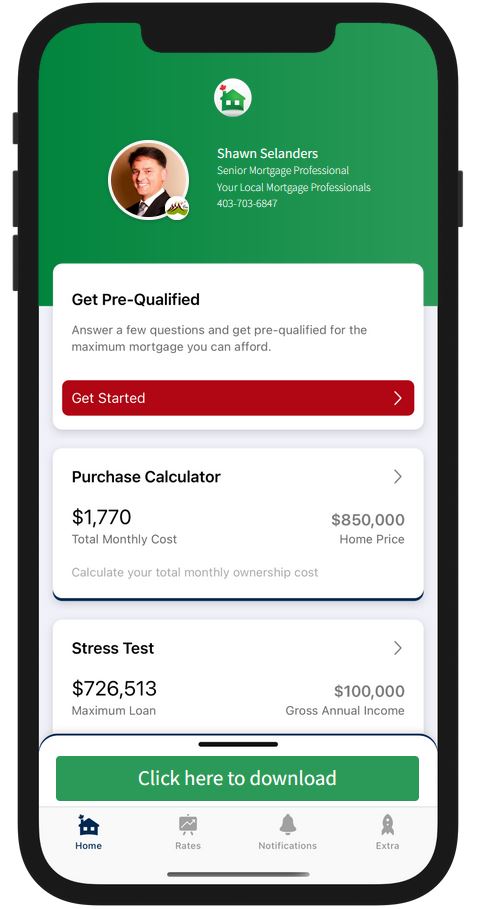
Mortgage calculators, affordability tools, and rate comparisons from 30+ lenders — right on your phone.


One call. Straight answers.
Buying, renewing or refinancing in High River? You’re talking to your neighbour, not a call centre.
403-703-6847or Apply Online →
Shawn Selanders — RECA-licensed mortgage broker, Senior Mortgage Professional with Mortgage Architects. Living and working in High River and serving Okotoks, Calgary, Foothills County, Diamond Valley and Southern Alberta since 1999.
Flood mitigation details from the Town of High River. Flood hazard designations, insurance availability and lender requirements vary by property — confirm specifics for any address you’re considering.