
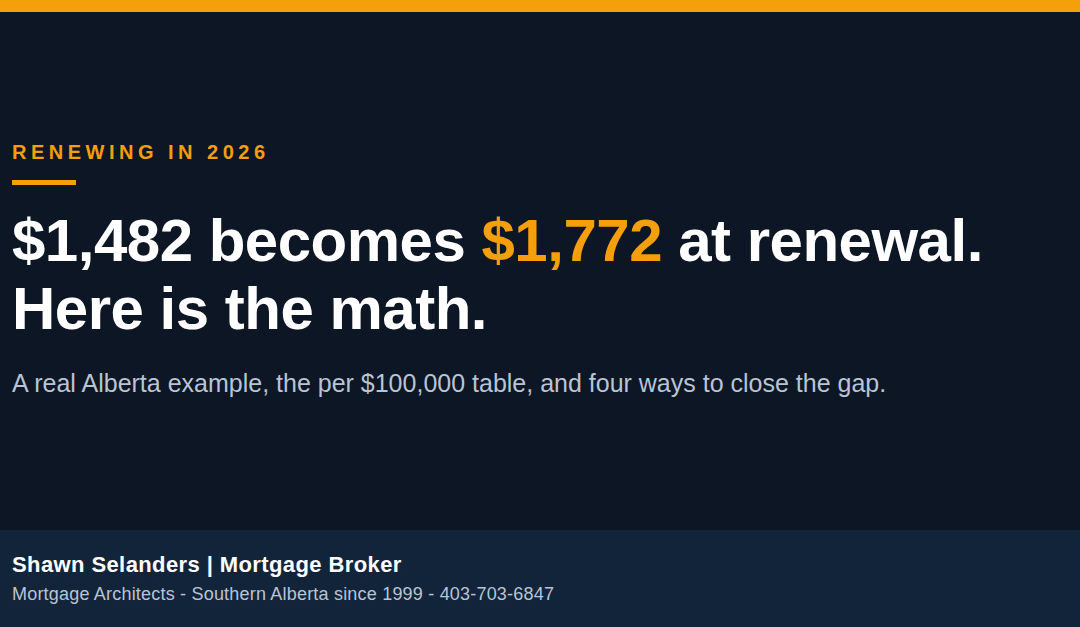
| ▶ | $350,000 from 2021 at 2%: $1,482 a month. Renew the $293,200 left at 4% over 20 years: $1,772. Up $290. |
| ▶ | The 5-year bond went from about 3.3% to 3.69% in a month. Fixed rates jumped up to a full point at some lenders. |
| ▶ | Four ways to close the gap: shop it and take the right hold, a lump sum, the amortization, kill the card debt. |
| ▶ | Everybody says four months. I say six - and select lenders will lock a rate a full year out. |
This is the question I get more than any other right now, and you can answer it yourself in about five minutes. You need two numbers and one table.
Bank of Canada staff estimated that about 60 percent of all outstanding Canadian mortgages renew in 2025 or 2026. For the five year fixed crowd renewing this year, their analysis put the average payment increase at roughly 20 percent. That is the headline. Your file is not the headline, so let us work out your actual number.
Step one, find your two numbers
Dig out your most recent mortgage statement. You want your current balance and your maturity date. Most people cannot tell me either one off the top of their head, and both are printed right there.
While you are in there, note your remaining amortization. If you took a 25 year mortgage five years ago, you have 20 years left, and that shorter runway is part of why the payment climbs.
Step two, the table
Here is what $100,000 of mortgage costs per month, by rate and amortization. Find your rate, multiply by your balance in hundred thousands.
| Rate | 25 year amortization | 20 year amortization |
|---|---|---|
| 2.00% | $423 | $505 |
| 3.00% | $473 | $554 |
| 4.00% | $526 | $604 |
| 4.50% | $553 | $630 |
| 5.00% | $582 | $657 |
So a $300,000 balance at 4.50 percent over 20 years is 3 times $630, or about $1,890 a month. Close enough to plan with.
A real example
Say you bought in 2021 with a $350,000 mortgage at 2.00 percent, 25 year amortization. Your payment has been $1,482 a month.
Five years of payments later your balance is about $293,200, and you have 20 years of amortization left.
Renew that balance at 4.00 percent over 20 years and the payment becomes $1,772. That is $290 more a month, almost exactly the 20 percent the Bank of Canada projected.
Two hundred and ninety dollars is a real hit to a household budget. It is also not the end of the world, and there are four things you can do about it.
Why this got more urgent in the last six weeks
Fixed mortgage rates are built on the five year Government of Canada bond yield, and that yield has been climbing hard. On September 24, 2026 it closed at 3.69 percent. In late August it was about 3.3 percent. That is close to half a point in a month.
Lenders followed. Canadian Mortgage Trends reported on September 12 that fixed rates were repriced by anywhere from 20 basis points to almost 100 in a single week, and that some lenders quietly pulled discretionary discounts of up to 40 basis points on top of that.
Plain version: the five year fixed available in mid-August is meaningfully more expensive today, and depending on the lender the gap is around three quarters of a point. If you ran your number off the 4.00 percent row in that table, run it again on the 4.50 and 5.00 rows. That is the range this market is living in right now.
Which is exactly why the hold matters more than it did in the spring.
Four ways to close the gap
One, shop the rate and take a hold. The offer on the renewal letter is an opening bid. Since OSFI dropped the stress test on straight switches between federally regulated lenders, same balance and same amortization, moving your mortgage is easier than it has been in years. I went through that in detail in why the renewal letter is not a bill.
The hold is the part people underuse. Most lenders will hold a rate 120 days. Some go to 150 or 180. Past that it gets rare, but select lenders will lock a rate a full twelve months out on a renewal or a straight switch. Most homeowners have never heard of that, because the bank that mailed you the letter has no reason to mention it.
A rate hold only works in one direction, and that is the point. If rates keep climbing, you keep the rate you locked. If they fall, you take the better one. You are not betting. You are buying insurance.
But read this before you ask me for twelve months. On a fixed rate, the long holds are not a small premium. Looking at the lender sheets on my desk right now, stretching a five year fixed hold from the short window out to nine or twelve months can cost you well over a full percentage point. At that price it stops being insurance and starts being a worse mortgage.
On a variable it is a completely different story. The same stretch typically costs about a tenth of a point off your discount. So if you are nine or twelve months from maturity and you want protection locked in, the variable hold is usually the smarter door, and most of those products let you convert to a fixed later if you change your mind.
That is the kind of thing that is invisible from the outside and obvious once someone shows you the sheets. It is also why I would rather spend ten minutes on your file than have you guess.
Two, lump sum before you renew. Every prepayment privilege you have left resets at renewal, and anything you put down before maturity comes straight off the balance with no penalty. Ten thousand dollars off a $293,000 balance at 4.00 percent is about $60 a month off the new payment.
Three, stretch the amortization with your eyes open. Going back out to 25 years drops that $1,772 to about $1,542. It also means five more years of interest. This is a cash flow tool, not a savings tool, and I will say so plainly if you ask me.
One caveat on the switch, because people mix these up. A straight switch means same balance, same amortization. That is what skips the stress test and earns the best hold pricing. The moment you increase the loan amount, to absorb debt or to take cash out, it becomes a refinance. The stress test comes back and the extended hold pricing generally does not apply.
That does not make a refinance a bad move. It just means the two plays are different, and you should know which one you are making before you start.
Four, deal with the consumer debt at the same time. This is the one most people miss. If you are carrying cards or a line of credit at 19.99 or 20.99 percent, renewal is the cheapest moment to roll that into the mortgage, because there is no prepayment penalty when the term is ending anyway. Sixty thousand dollars of card debt at 20 percent costs about a thousand a month in interest alone. Moving it can free up more cash flow than the rate ever will. Run it on the debt consolidation calculator before you decide.
One more thing, if you are on a variable
The same Bank of Canada analysis projected that variable rate, variable payment holders would see payments come down roughly 5 to 7 percent. If that is you, you are on the good side of this. Shop your renewal anyway, because the discount off prime is negotiable and it is the only time you get to move it.
The move this month
Get your balance and your maturity date on a sticky note today. Then do the table math and find out what your number actually is, instead of carrying around a vague dread about it.
Everybody tells you to start at four months. I say six - get organized then, so the morning the whole board of 30+ lenders opens at four months, the best offer gets locked, not the first one. If your maturity date is further out than that, ask me about the twelve-month hold. With yields moving the way they have been, locking the right kind of hold early costs you very little and can be worth real money. Six months out I can do something about it. Four weeks out, less.
Let us run your actual numbers
Bring me your balance, your maturity date and your current payment. Twenty minutes and you will know exactly what your renewal turns into, what your options are for softening it, and which kind of hold is worth paying for on your file.
Call or text 403-703-6847Shawn Selanders, Mortgage Broker with Mortgage Architects, serving High River, Okotoks, Calgary, Foothills County and Southern Alberta since 1999, with access to 30+ lenders. All payment figures are illustrations calculated on semi-annual compounding and are not quotes or an offer of credit. Your actual payment depends on your rate, balance, amortization and lender. Rate hold lengths and pricing vary by lender and product, change without notice, and are subject to approval. Rates and bond yields change without notice. All lending O.A.C. E.&O.E. Sources: Bank of Canada benchmark bond yields, September 24, 2026; Canadian Mortgage Trends, September 12, 2026; Bank of Canada Staff Analytical Note 2025-21, How will mortgage payments change at renewal, July 2025; OSFI, Minimum qualifying rate for uninsured mortgages.