
Mortgage Calculators
Free Tools & Resources
Download My Mortgage App — It's Free
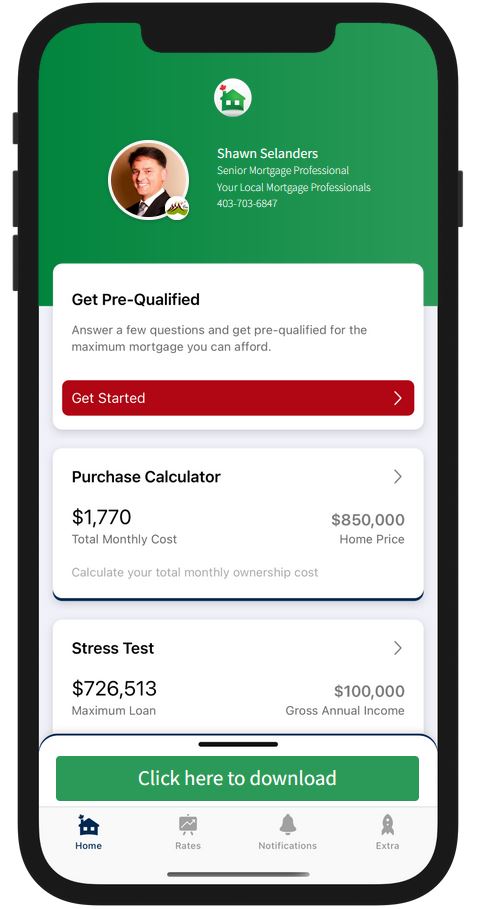
Access real-time rates from 30+ lenders, mortgage calculators, stress test tools, side-by-side comparisons, and more.


Which Calculator Do You Actually Need?
There are a lot of tools here, which is the problem if you do not know where to start. So here they are sorted by what you are actually trying to figure out.
Every one of them is free, none of them ask for your email, and none of them send you anything. Run your numbers, close the tab, and if it raises a question you cannot answer, call me.
I am thinking about buying my first home
- How much can I afford? - the two ratios lenders actually use, and what the stress test does to your number.
- Down payment savings timeline - how long until you can buy, including the FHSA and the Home Buyers' Plan.
- FHSA and RRSP down payment - how much you can put down tax free using the government programs.
- What will my payment be? - the full monthly cost, the insurance premium, and cash to close.
- Rent or buy? - the wealth difference over five, ten and twenty five years.
- Should I wait? - what waiting costs, and when waiting is genuinely the right call.
I am choosing between mortgage options
- Fixed or variable? - both side by side, plus what happens if rates move.
- Compare three options - competing offers, different amortizations, different terms.
- Bank or broker? - what the rate difference is actually worth over your term.
I already have a mortgage
- Pay it off faster - payment frequency, higher payments and lump sums, with a real example from one of my own mortgages.
- Full amortization schedule - every payment, principal against interest, and your balance at renewal.
- Should I refinance? - including the penalty, which is the part that decides it.
- Debt consolidation - what rolling high interest debt into your mortgage actually saves.
Something more specific
- Rental property - cash flow, cap rate and the mortgage side of an investment property.
- Reverse mortgage - how much tax free equity you could access at fifty five and over.
How to Use These Without Fooling Yourself
A calculator is a very confident liar if you feed it optimistic numbers. A few things worth knowing before you trust an answer.
The rate you type is not the rate you get. Your actual rate depends on your credit, your income, the property, the term and which lender your file belongs at. Use a realistic number, not the best one you saw advertised.
You do not qualify at your rate. Under the stress test you qualify at the greater of your contract rate plus two percent, or 5.25 percent. That single rule catches almost everybody the first time.
Run the boring version. Whatever you are modelling, run it once with modest assumptions. If it still works in the boring version, that means something. If the whole case depends on everything going right, that is a bet, and you should know you are making it.
The payment is not the whole cost. Property taxes, insurance, utilities, maintenance, and condo fees where they apply. A number that only counts principal and interest always looks better than reality.
Why These Are Here
Twenty five plus years in this business and the same thing happens over and over. Somebody makes a large financial decision based on a number they half remember from a conversation, or a rule of thumb from a relative, or an advertised rate that was never going to apply to them.
These tools exist so you can see your own numbers before you talk to anybody, including me. You should walk into a mortgage conversation knowing roughly what the answer ought to be. It is a lot harder to be sold something when you already understand the math.
If a number here surprises you, that is worth a phone call. Not to be talked into anything, just to find out whether the surprise is real.
Frequently Asked Questions
Q: Are these calculators free, and do I have to give you my email?
They are free and there is no email required. No sign up, no drip campaign, nothing sent to you afterward. Use them as many times as you like. If you want to talk, you call me.
Q: How accurate are they?
The math uses standard Canadian semi-annual compounding, so the calculations themselves are sound. Accuracy depends on your inputs. A real quote also depends on lender guidelines, your credit, your income and the property, which no calculator can see. Treat the results as a solid estimate to plan with, not a commitment to lend.
Q: Which calculator should I start with?
If you are buying, start with affordability, then the payment calculator. If you already own, start with the amortization schedule so you can see where you actually stand, then the payoff strategy tool. If you are renewing, the comparison calculator is the one.
Q: Do these work for acreages and rural properties?
The math does. The lending is a different story. Acreages, manufactured homes and rural properties come with lender specific rules on land size, water, septic and outbuildings that no calculator accounts for. If that is what you are buying, run the numbers here and then have a conversation, because the property type often matters more than the payment.
Q: Can I use these if I am self employed?
Yes, but be careful with the income field. Most lenders assess self employed borrowers on net income after write offs rather than gross revenue, so entering your gross will give you an answer that is too optimistic. There are lender programs designed for business owners, which is a conversation rather than a calculation.
Then What?
Run whatever is relevant, write down the number that surprised you most, and bring it to a conversation. That is the fastest way I know to turn a vague worry about money into a plan you can act on.
Ran the numbers and have a question?
Call or text 403-703-6847. To get you a straight answer fast, have these handy: your rough annual income, your monthly debt payments, what you have saved, and either the price range you are shopping or your current mortgage details.
Shawn Selanders is a RECA-licensed mortgage broker with Mortgage Architects, serving High River, Okotoks, Calgary, Foothills County and Southern Alberta since 1999. Calculator results are estimates for planning purposes and are not a commitment to lend.