
Vacation Home, Cottage & Second Property Financing in Alberta
Written by Shawn Selanders | RECA-Licensed Mortgage Broker | 25+ Years Experience | Updated March 2026
Most people think you need 20% down for a second property. For many situations, you could need as little as 5%.
The difference comes down to three things: how the property is classified, which lender you use, and which mortgage insurer backs the deal. The same lakefront property can require anywhere from 5% to 35% down depending on these factors.
This page explains exactly how it works — the rules, the exceptions, and the real-world situations I deal with every week.
💰 The Down Payment Myth — Exposed
Ask most people how much you need for a second property and they'll say 20% or 25%. That's true for investment properties — but NOT for owner-occupied second homes or properties where a family member will live.
With the right lender and insurer combination, you can finance a second home with as little as 5% down, just like a primary residence. On a $400,000 cottage, that's the difference between $20,000 and $80,000+ upfront.

This Is Where a Broker Earns Their Keep
I'm Shawn Selanders — an independent mortgage broker in Alberta since 1999. Second property financing is where the differences between lenders are massive. One bank might quote you 35% down while another approves you at 5%. Same property, same borrower — wildly different answers.
I know which lenders are flexible, which insurers cover which property types, and how to structure the deal so you qualify to carry both properties.
My service costs you nothing. The lender pays my fee. You get expert guidance for free.
What's on This Page
- The Down Payment Myth
- Three Ways to Buy a Second Property
- What's Required for 5% Down
- The Three Mortgage Insurers — Different Rules
- Where It Gets Complicated — Lender Classification
- How Mortgage Insurance Works for Second Homes
- What "Owner-Occupied" Actually Means
- Year-Round vs Seasonal Properties
- Carrying Two Properties — The Qualification Challenge
- Property Taxes, HOA Fees & Hidden Costs
- Frequently Asked Questions
- Talk to Shawn — Free Consultation
1. The Down Payment Myth
Ask most people how much you need for a second property and they'll say 20% or 25%. That's true for investment properties — but NOT for owner-occupied second homes or properties where a family member will live.
With the right lender and insurer combination, you can finance a second home with as little as 5% down, just like a primary residence. The key is understanding the difference between an investment property (rented to a third party — always 20% minimum) and an owner-occupied second home (you or your family uses it).
The bottom line: Don't assume you need 20% down for a second property. Talk to a mortgage broker before you start saving or pass on a property you love. The answer might surprise you — and it could save you $60,000+ in upfront costs.
2. Three Ways to Buy a Second Property
Owner-Occupied Second Home
Down payment: As low as 5%
You or an immediate family member lives in the property. This qualifies for insured financing with any of the three mortgage insurers.
Vacation / Seasonal Property
Down payment: 10%–50% (depends on lender)
Cottage, cabin, or seasonal-use property. Requirements vary dramatically by lender and by whether the property is winterized.
Investment / Rental Property
Down payment: 20% minimum — always
If the property is rented to a third party, it's classified as investment. No insured financing available. No exceptions.
3. What's Required for 5% Down on a Second Property?
Not every second property qualifies. Here's what insurers look for:
Requirements for 5% Down (Insured Second Home)
✅ Property must be occupied by the borrower or immediate family member (rent-free)
✅ Property must be suitable for year-round occupancy (proper heating, winterized plumbing, year-round road access)
✅ You must qualify to carry both properties under the stress test
✅ The property cannot be rented to a third party
✅ Standard lending requirements (credit score, income verification, etc.)
4. The Three Mortgage Insurers — Different Rules
Canada has three mortgage default insurers, and they each treat vacation/second properties differently. This is where the confusion starts — and where a broker adds serious value.
| Scenario | CMHC | Sagen | Canada Guaranty |
|---|---|---|---|
| Year-round second home | ✓ 5% down | ✓ 5% (Type A) | ✓ 5% down |
| Seasonal / no permanent heat | ✗ Not eligible | ✓ 10% (Type B) | ✗ Not eligible |
| Boat-access only | ✗ No | ✓ Type B | ✗ No |
| Family member occupies | ✓ 5% down | ✓ 5% down | ✓ 5% down |
| Rental / investment | ✗ 20% min | ✗ 20% min | ✗ 20% min |
| Max insured properties | 2 per borrower | 1 vacation per borrower | Varies |
| Borrowed down payment | Restricted | Type B: No gifted DP | ✓ Allowed |
| Must be winterized | Yes | Type A: Yes / Type B: No | Yes |
Key takeaway: Sagen is the only insurer that will cover seasonal properties (Type B) at 10% down. If the property doesn't have year-round heat and plumbing, your options narrow to Sagen or conventional (20%+ down) financing.
5. Where It Gets Complicated — Lender Classification
Even if an insurer WILL cover the property, the lender decides how to classify it — and that classification determines your down payment. The same property at different banks can require wildly different down payments.
| Same Property → | Seasonal Use | Year-Round Capable | Family Lives There |
|---|---|---|---|
| TD Bank | "Cottage" — 10% insured or 50% conv. | "Recreational" — 35% down! | "Second Home" — 5% down |
| Scotiabank | Type B — 10% insured | Type A — 5% insured | Type A — 5% insured |
| RBC | Up to 95% with insurance | Up to 95% with insurance | Up to 95% with insurance |
This Is Why You Need a Broker — Not a Bank
If you walk into TD and ask about a year-round capable vacation property, they may classify it as "Recreational" and quote you 35% down. The exact same property through a different lender might be 5% down. A bank employee can only offer you their bank's classification. A broker shops the entire market.
6. How Mortgage Insurance Works for Second Homes
Canada has three mortgage default insurers: CMHC (a crown corporation), Sagen, and Canada Guaranty (both private). All three can insure second homes under certain conditions.
CMHC now allows insured mortgages on up to two properties per borrower at any given time. The key requirement is that the property must be occupied by the borrower or an immediate family member — not rented to a third party.
Insurance premiums work the same as on a primary residence — they're based on the loan-to-value ratio and are added to the mortgage. The premium is a one-time cost, not an ongoing fee.
7. What "Owner-Occupied" Actually Means
Under CMHC guidelines, a property qualifies as owner-occupied if at least one unit is occupied rent-free by:
✅ The borrower themselves
✅ A person related to the borrower by marriage or common-law partnership
✅ A legal parent or child of the borrower
This is the rule that opens the door to 5% down for family-occupied properties.
Your adult child living in the home while attending university? Qualifies. Your aging parent downsizing from the family home? Qualifies. Your brother renting it from you at market rate? Does NOT qualify.
8. Year-Round vs Seasonal Properties
For insured financing, the property must be suitable for year-round occupancy. This means:
• Proper heating system (not wood stove only)
• Winterized plumbing
• Adequate insulation
• Year-round vehicular access
Many vacation properties in Alberta's mountain and lake communities meet these criteria — especially in Canmore, Sylvan Lake, and Invermere where full-service homes are common. Remote seasonal cabins without winter road access typically require conventional (20% down) financing.
The exception: Sagen's Type B program is the only insured option for seasonal properties. It requires 10% down, does not allow gifted down payments, and limits you to one vacation property per borrower. It's not as generous as the year-round programs, but it's far better than the 20%–50% conventional options.
9. Carrying Two Properties — The Qualification Challenge
The down payment is often the easy part. The harder question is whether you qualify to carry both properties simultaneously.
Lenders add the costs of both homes — both mortgages, both property taxes, both heating costs, and any condo or HOA fees — into your GDS and TDS ratios. You must pass the stress test on both.
What Gets Added to Your Debt Servicing
✅ Both mortgage payments (at qualifying rate — typically contract rate + 2%, or 5.25%, whichever is higher)
✅ Both property tax bills
✅ Both heating costs
✅ Condo fees at 50% (if applicable)
✅ HOA fees at 100% (if applicable)
✅ All existing debts (car payments, credit cards, lines of credit)
This is where a mortgage broker earns their keep: they know which lenders have the most flexible qualification criteria for multi-property borrowers, and they can structure the financing to maximize your approval chances.
10. Property Taxes, HOA Fees & Hidden Costs
Don't forget that a second property means a second set of property taxes, possibly a second set of community or HOA fees, and additional insurance.
Fee Impact on Qualification:
• Condo fees: 50% counts in your debt servicing ratios
• HOA fees: 100% counts in your debt servicing ratios
A $400/month HOA fee at a lake community hits your qualification twice as hard as a $400/month condo fee. Same dollar amount, dramatically different impact on how much you can borrow. Budget for these costs and make sure your mortgage broker includes them in your qualification estimate.
11. Frequently Asked Questions
Can I really buy a cottage with only 5% down?
Yes — if the property meets certain criteria (year-round access, suitable for full-time occupancy) and you qualify with the stress test carrying both properties. Not every cottage qualifies, but many do. A mortgage broker can assess the specific property.
Can I buy a house for my parents/child to live in with 5% down?
Yes. If an immediate family member (parent, child, spouse) occupies the property rent-free, it qualifies as owner-occupied under CMHC guidelines. Standard insured mortgage rules apply, including the 5% minimum down payment.
Can I borrow the down payment for a second property?
In some cases, yes. Unlike primary residences where borrowed down payments have restrictions, second home financing through some insurers (notably Canada Guaranty) allows borrowed funds from a line of credit or personal loan. However, this adds to your debt load and affects qualification. Discuss with your broker.
What if I want to rent out the cottage part-time (Airbnb)?
This is a grey area. If the property is insured as owner-occupied, renting it on Airbnb may violate your mortgage terms. Some lenders are more flexible than others. If short-term rental income is part of your plan, be upfront with your broker so they can find a lender and structure that allows it.
How many properties can I have with insured mortgages?
CMHC allows up to 2 insured properties per borrower at any given time. Sagen and Canada Guaranty have their own limits. Beyond that, you're into conventional (20% down) territory. A broker can help you plan the most efficient path if you're building a multi-property portfolio.
12. Talk to Shawn — Free Consultation
Whether it's a mountain cabin, a lake house, a home for your parents, or a place near your kid's university — I have the experience and the lender relationships to make it happen. One call. Real answers.
Thinking About a Second Property? Let's Talk.
I'll review your situation, explain your options, and tell you exactly what you qualify for — including which insurer and lender combination gives you the lowest down payment. Free, no obligation.
Want to keep this information?
📥 Download the Free Guide (PDF)Call/Text: 403-703-6847
Email: Shawn@ShawnSelanders.ca
Office: 614 High View Park NW, High River, AB T1V 1E5
Hours: Monday to Friday: 9:00 – 7:00 | Saturday & Sunday: 12:00 – 5:00
Helping Albertans buy vacation homes and second properties, including:
📊 Check Your Credit Score Before You Apply
Know where you stand. Free, fast, and it won't affect your score.
Click For a Free Credit Check ↗📱 Download My Mortgage App — Calculators, Rates & More
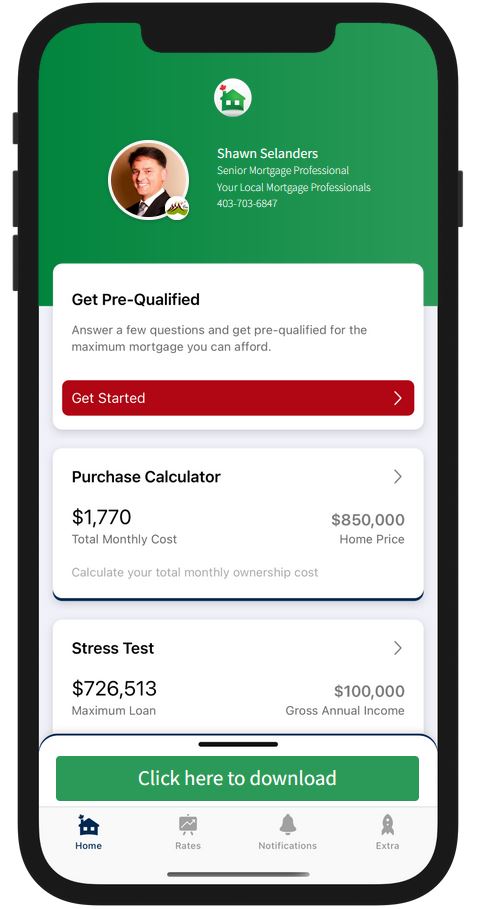
Affordability calculators, real-time rates from 20+ lenders, and the ability to start your application — right from your phone.


Serving Calgary, Okotoks, High River, and all of Alberta since 1999
This page is for informational purposes only and does not constitute financial advice. Mortgage approval is subject to lender criteria and conditions. Rates, terms, insurer guidelines, and programs are subject to change. Down payment requirements shown are based on current guidelines and may vary by lender and property classification. O.A.C. E.&O.E.